(+86)-025-86106536 (+86)-13705159108

 English
- All
- Product Name
- Product Keyword
- Product Model
- Product Summary
- Product Description
- Multi Field Search
Views: 0 Author: Site Editor Publish Time: 2026-04-24 Origin: Site
When comparing ASRS vs. Manual Warehousing, it’s clear that ASRS delivers faster and more accurate results. Nova Intelligent stands out as a leader in smart logistics, leveraging automation to significantly improve warehouse operations. Recent data highlights that, in the debate of ASRS vs. Manual Warehousing, ASRS consistently achieves higher throughput and greater accuracy.
Metric | ASRS Performance | Manual Warehousing Performance |
|---|---|---|
Throughput | Much higher rates | Slower due to manual labor |
Order Fulfillment Speed | Faster with continuous automation | Slower, limited by human speed |
Accuracy | Highly accurate, minimal errors | More errors due to human involvement |
Nova Intelligent is recognized for its innovation and industry leadership. The company regularly attends industry expos, demonstrates how automation transforms warehouse operations, and collaborates with other industry leaders to share insights and advancements.
For businesses evaluating ASRS vs. Manual Warehousing, ASRS is the superior choice for optimizing warehouse efficiency and performance.
ASRS systems help fill orders faster. This lets warehouses move more items in less time.
Automated systems like ASRS use tall shelves well. This can make storage space bigger by up to 80%.
ASRS cuts down on mistakes made by people. It can be right 99.9% of the time, which is better than doing it by hand.
Automation lets warehouses work all day and night. They can meet hard deadlines without stopping or taking breaks.
Buying ASRS can save money over time. Many companies get their money back in two to four years.
ASRS systems can be changed or made bigger easily. This helps when a business grows or needs something new.
Using ASRS makes work safer. It means people do less heavy lifting and get hurt less often.
For businesses with lots of orders, ASRS is the best way to stay fast and correct.
ASRS can change how you use your warehouse. This system lets you use almost all the tall space in your building. Some ASRS systems can go higher than 100 feet. You do not need big aisles for forklifts anymore. The system moves items up and down very carefully. You can fit more things in the same spot.
ASRS can use up to 85% of your warehouse’s height.
You can store 50-80% more without making your building bigger.
High-bay ASRS can stack items much higher than manual warehousing.
Nova Intelligent’s ASRS and strong pallet racks help you use every bit of space. For example, Nova helped JD in Guangzhou and Toyota in Oman triple their storage with ASRS. You can see how ASRS lets you store more without needing a bigger warehouse.
Manual warehousing has some limits. You need wide aisles for people and forklifts. You cannot stack things very high because of safety and equipment. Most manual warehouses use only 40-60% of the tall space. This means you lose a lot of storage room.
Aspect | Manual Warehousing | ASRS |
|---|---|---|
Vertical Space Utilization | Less than 30% used | Maximized use of vertical space |
Aisle Width Requirements | Requires wide aisles | Operates in narrower spaces |
Flexibility | Fixed rack configurations | Modular and adjustable architecture |
Expansion Needs | Structural modifications needed | Scalable without major changes |
ASRS helps you save a lot of floor space. You can store three times more items in the same area. You do not need to make your building bigger to hold more goods. Nova Intelligent’s ASRS projects have shown up to 300% more items stored in the same space. This means your business can grow without moving to a new place.
ASRS uses tall space, so you do not need more floor area.
You can spend less on workers and energy because the system saves power.
ASRS gives you more choices. You can change the system if your needs change. You do not need to rebuild your warehouse. The system’s design lets you add or move parts easily. Manual warehousing often needs big building work for changes. With ASRS, you can grow fast and keep working without stopping.
Tip: If you want your warehouse ready for the future, pick ASRS. It is easy to upgrade and helps you use space better.
You will notice a big change in picking speed with ASRS. The system brings bins right to the picking stations. Workers do not waste time walking or looking for things. Robots work at the same speed all day long. This gives you steady results every hour.
Here is a table that shows how ASRS and manual warehousing compare:
Manual Warehousing | ASRS |
|---|---|
Average picking rate: 50 units/hour | Up to 600 lines/hour per station |
Walking time slows down throughput | Direct bin delivery speeds up picking |
Human speed changes during the day | Robots keep a steady pace |
Idle time between picks | Continuous bin presentation |
You can count on ASRS to keep your warehouse running well. The system does not slow down, even with lots of orders.
ASRS works all day and night. You do not have to worry about breaks or shift changes. Robots keep picking and storing items without stopping. This gives you more choices and helps you meet tight deadlines. You can handle urgent orders without waiting for workers.
Note: ASRS lets your warehouse run all the time. You can get more work done and keep up with demand.
Manual warehousing depends on people to do the work. Workers get tired after many hours. When people get tired, they make more mistakes. Heavy lifting and bad work setups make the job harder. Many workers quit because the job is tough.
Tired workers can get hurt more easily.
Long hours and heavy work slow down the team.
Bad work setups can cause injuries and make people leave.
You need to buy safe tools and good floors to help your team. Even with these changes, manual warehousing is not as fast as ASRS.
Manual warehousing has times when work stops. Workers need to take breaks and change shifts. You lose time when people rest or switch jobs. Messy aisles and hard-to-reach items slow down picking. The warehouse setup affects how fast people can work.
Shift changes make things slower.
Breaks mean less work gets done.
Hard-to-find items slow down the team.
You have to plan for these problems with manual warehousing. The system cannot run all the time like ASRS.
ASRS works very well when things get busy. Robots move fast, up to 2.5 meters per second. The system can get 138 bins every hour. You can add more robots or storage as your business grows. The system’s design lets you make it bigger when you need to.
ASRS keeps working well, even when it is busy.
Robots bring bins right to workers and save time.
The system can handle more SKUs as you grow.
You do not need to worry about slowdowns or traffic jams. ASRS keeps your warehouse running well, even when you are busy.
Nova Intelligent’s ASRS systems have helped many companies do better. Nine Dragons Paper in Chongqing used robots to store more and work faster. The system helped them save money and work safer. Automation made the workplace better for everyone.
Here is a table that shows important results from Nova Intelligent’s projects:
KPI | Description |
|---|---|
Storage Productivity | How much you store per square foot |
Space Utilization | How well you use your warehouse space |
Order Lead Time | How fast you ship orders after receiving them |
Cost per Storage Location | How much you spend for each storage spot |
Availability | How often your system works without stopping |
You can see that ASRS helps every part of warehouse work. The system lets you store more, ship faster, and save money. Nova Intelligent’s solutions show real results in real warehouses.
Tip: If you want to handle lots of orders and keep your warehouse working well, ASRS is the best choice. You can trust the system to work the same way every time and move lots of items.
You can count on ASRS to track every item. Machines and software help move goods fast and right. You always know where your products are. It does not matter how big or heavy they are. ASRS gives you updates on your inventory right away. You do not have to count things by hand. You also do not need to worry about missing items. Automated warehousing lets you see your stock at any time.
ASRS stops mistakes before they happen. The system checks each step and warns you if something is wrong. You do not need to remember everything or guess. Automated warehousing means less work for people, so there are fewer mistakes. Picking and storing items is smooth and works well. You can see how ASRS makes your warehouse better and more correct.
Manual warehousing needs people to pick, pack, and move things. People can get tired or lose focus. This can cause mistakes like picking the wrong item or missing an order. Studies show manual picking can have error rates up to 4%. Automated systems like ASRS lower this to just 0.04%. You can see the difference in the table below:
Process Type | Error Rate |
|---|---|
Manual Picking | Up to 4% |
Automated Systems | 0.04% |
Manual warehousing often causes problems with counting items. You might run out of stock, lose products, or have late deliveries. These problems can make you lose sales and upset customers. Common risks include:
High mistake rates in picking and packing
Slow order shipping
Unhappy customers
More costs from mistakes and injuries
Getting orders right is important to your customers. With ASRS, you can reach picking accuracy as high as 99.9%. This means your customers get the right items on time. Automated warehousing also makes orders faster. Some systems can fill orders in just 90 seconds. Fast and correct orders make customers happy and want to come back.
Mistakes in manual warehousing can cost you money. You might lose sales or pay more to fix problems. ASRS helps you save money by catching mistakes early and updating inventory right away. Here is a quick look at how costs compare:
Aspect | Manual Warehousing | ASRS System |
|---|---|---|
Mis-pick rates | High | Low |
Feedback for incorrect picks | None | Immediate alerts |
Inventory tracking | Manual | Real-time |
High | Stays accurate |
You can see that ASRS and automated warehousing give you better control, fewer mistakes, and happier customers. This means better order fulfillment and lower costs for your business.
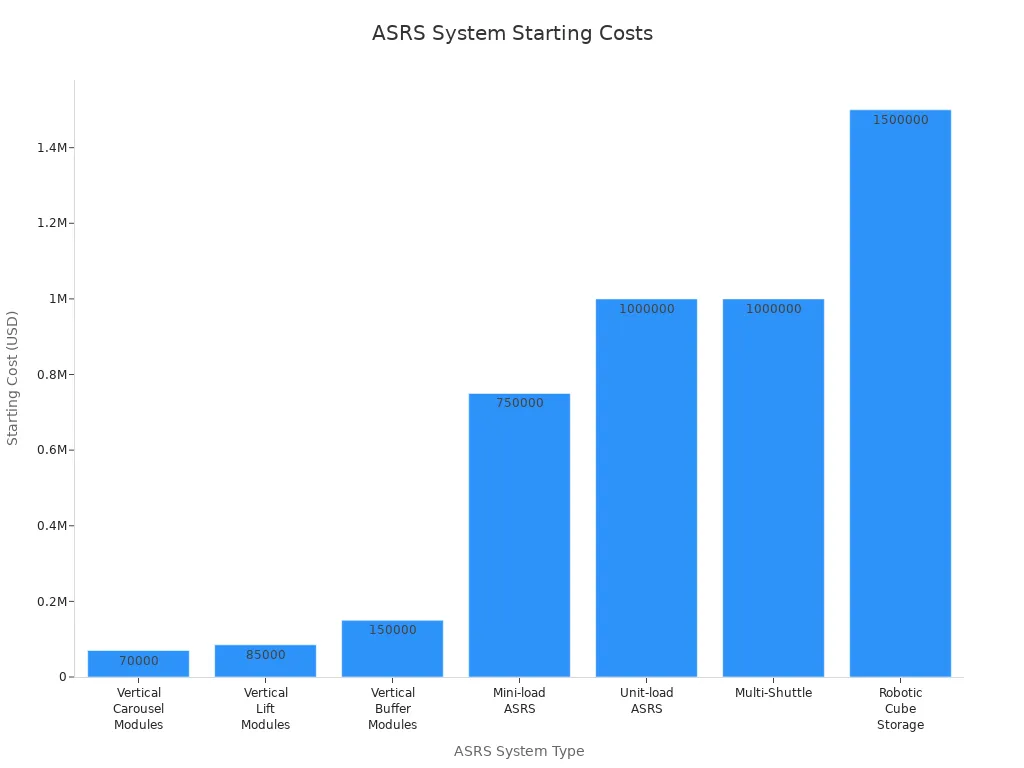
When you look at ASRS, the price is higher at first. The cost changes based on which system you pick. Here is a table that shows how much different ASRS systems cost to start:
ASRS System Type | Starting Cost |
|---|---|
Vertical Carousel Modules | $70,000+ |
Vertical Lift Modules | $85,000+ |
Vertical Buffer Modules | $150,000+ |
Mini-load ASRS | $750,000+ |
Unit-load ASRS | $1,000,000+ |
Multi-Shuttle | $1,000,000+ |
Robotic Cube Storage | $1,500,000+ |
Manual warehousing usually costs less when you start. You do not need special machines or software. But, paying less at first can mean you spend more later.
ASRS helps you save money over time. Machines do most jobs, so you need fewer workers. You also use your space better and can store more things. Many companies get their money back in two to four years. Here is a table that shows how ASRS makes your warehouse better:
Benefit | ASRS Improvement |
|---|---|
Space Optimization | Up to 60% increase in capacity |
Labor Cost Reduction | Up to 70% savings |
Enhanced Order Accuracy | Picking accuracy > 99.9% |
Improved Throughput | Up to 70% increase in speed |
You can fill orders faster, make fewer mistakes, and pay less for workers. Nova Intelligent’s customers say they save a lot and their warehouses work better after using ASRS.
Manual warehousing needs people for every job. You have to hire, train, and keep workers. If workers leave, it can cost a lot to replace them. Hiring a new worker can cost up to twice their yearly pay. Workers also spend time looking for things, which slows them down. In the United States, big companies lose millions each year because workers cannot find what they need.
High turnover means you spend more money.
Training new workers takes time and costs money.
Lost time from searching for things adds up.
You keep paying for workers, safety gear, and repairs in manual warehousing. These costs never go away. If you want to grow, you need more workers and tools. Over time, these costs can be much higher than what you saved at first.
Manual warehousing often stops when workers take breaks or change shifts. Mistakes can cause lost or broken items, called shrinkage. These problems cost your business money. ASRS cuts downtime because machines work all the time. You also lose fewer items because the system tracks everything.
ASRS makes your warehouse work better. You use less space, move things faster, and make fewer mistakes. Automation also makes your warehouse safer. You spend less on injuries and insurance. Nova Intelligent’s projects show that ASRS helps companies grow without spending more.
Tip: When you think about costs, remember both short-term and long-term expenses. ASRS may cost more at first, but it saves you a lot of money later.
You can make your warehouse bigger with modular upgrades. Nova Intelligent builds systems that let you add storage without stopping work. You do not have to build new walls or move everything. The modular design lets you grow fast when your business gets bigger or you need more space for new things.
Here is a table that shows how expansion is different:
Aspect | Manual Warehousing | |
|---|---|---|
Expansion Requirements | Needs new infrastructure | Modular design allows fast expansion |
Performance Under Demand | Slows down with more orders | Stays fast even when busy |
Scalability Dependency | Needs more workers | Uses robots, less labor needed |
Storage Layouts | Fixed, hard to change | Adjustable, fits your needs |
Productivity Impact | High turnover slows work | Automation keeps work steady |
You can link your ASRS to other smart warehouse tools. Nova Intelligent’s systems work with warehouse management, robots, and conveyor belts. This makes your warehouse smarter and faster. You can see your inventory right away, move goods with robots, and use data to plan better.
Technology Integrated | Benefits of Integration |
|---|---|
Warehouse Management System | Real-time inventory tracking, fewer mistakes |
Autonomous Mobile Robots | Faster material movement, lower costs |
Robotic Picking Systems | High accuracy in picking and packing |
Conveyor and Sortation | Quick order fulfillment |
IoT and AI Analytics | Real-time monitoring, better maintenance planning |
Tip: Using ASRS with other systems helps your warehouse grow and change as your business does.
You can make your manual warehouse more flexible by teaching workers new jobs. Train staff to do many tasks. This helps you handle busy times without hiring more people.
Cross-training lets you move workers where you need them.
You can keep up with changes in demand.
You can change your warehouse layout by picking flexible designs. Check your setup often and ask your team for ideas. This helps you adjust to new products or new ways of working.
Flexible layouts make it easy to add or remove shelves.
Regular checks help you find problems early.
ASRS works for both small and large warehouses. Vertical systems save space in small places. Shuttle-based systems handle lots of orders in big spaces. You can choose the best system for your needs.
ASRS Type | Best Use Case | Industry Example |
|---|---|---|
Vertical Solutions | Small parts, limited space | Manufacturing |
Shuttle-Based Systems | High order volume, many SKUs | E-commerce, consumer goods |
Unit-Load and Mini-Load Systems | Mixed inventory sizes | Manufacturing, logistics |
You can handle busy seasons with ASRS. The system keeps working fast, even with more orders. In manual warehouses, you can move workers or change layouts, but this takes more time and planning.
Note: ASRS helps you get ready for growth and change, so your warehouse is ready for the future.
ASRS keeps people away from dangerous places in the warehouse. Machines do the heavy lifting and moving instead of people. Workers do not need to walk where forklifts or falling things could hurt them. This makes accidents less likely and keeps everyone safer.
Here is a table that shows how ASRS safety features help reduce injuries:
Safety Feature | Impact on Workplace Injuries |
|---|---|
Removal from dangerous zones | Eliminates risks from falling objects and forklift collisions |
Reduction of manual labor | Decreases repetitive strain injuries and improves overall safety |
Automation of hazardous tasks | Reduces the need for employees in hazardous environments |
Elimination of manual handling | Significantly lowers the risk of workplace injuries |
Enhanced working conditions | Creates a safer and more comfortable environment for employees |
ASRS uses sensors and software to check for problems. If something is wrong, the system can stop right away. Machines always follow the same safety rules. This helps prevent accidents and keeps people safe. You can trust the system to work safely every time.
Tip: Machines do not get tired or lose focus, so they keep safety high all day.
Manual warehousing is more risky for workers. People lift heavy boxes, bend, and reach a lot. The injury rate is 5.5 for every 100 full-time workers. This is higher than most other jobs. Common injuries are back pain, pulled muscles, and sore wrists from doing the same thing over and over.
One injury can cost more than $43,000. Lost work and training new people make it cost even more. Big warehouses see more injuries, especially with lots of heavy lifting.
Manual work can make your body hurt. You might feel sore or tired after a long day. Some warehouses use powered lifts, soft mats, and work tables that move up and down. These tools help lower injury risks and help people work longer. But manual jobs are still hard on your body if you do them every day.
ASRS makes jobs easier and safer for workers. People do not have to lift heavy things or work in unsafe spots. This makes workers happier and helps them stay healthy. When you feel safe at work, you want to stay at your job longer.
ASRS means less hard work for people.
Safer jobs make workers happier and help them stay.
ASRS lowers the chance of injuries at work. This can make insurance cheaper and mean fewer claims. Fewer injuries also mean less lost time and fewer legal problems. Manual warehouses have more injuries, so they pay more for insurance and have more claims.
Evidence | Description |
|---|---|
ASRS reduces manual labor | Workers do not need to manually retrieve or store items, lowering injury risk |
Physical strain reduction | Automation prevents long-term health issues from heavy lifting |
Improved workplace safety | Safer environments lead to lower turnover and fewer insurance claims |
Note: Picking ASRS helps you make a safer and healthier place to work for everyone.
When you choose between ASRS and manual warehousing, you need to look at several important factors. Each warehouse is different. You should match your system to your needs. Here is a table that shows what you should think about:
Factor | Description |
|---|---|
Type of load | Think about what you store. Some systems work better for pallets, others for small boxes. |
Throughput requirements | Check how many items you move in and out each day. High volume may need automation. |
Warehouse layout | Look at your building. ASRS uses tall spaces. Manual warehousing needs wide aisles. |
Integration capabilities | Make sure your system works with your software and other tools. |
Budget constraints | Plan your spending. Think about how fast you want to see savings. |
You should check how many items you store and how many different products you have. If you handle thousands of items or many types of products, ASRS can help you keep track of everything. You get fast picking and fewer mistakes. If you only have a few products or low daily orders, manual warehousing can work well. You do not need complex systems for small operations.
You need to think about your budget. ASRS costs more at the start, but you save money over time. If you plan to grow your business, automation helps you scale up fast. Manual warehousing costs less at first. You pay more for workers and space as you grow. If you want to expand, plan for future needs now.
You should pick ASRS if you move a lot of goods every day. ASRS works best when you need speed and accuracy. You get fast order picking and almost no mistakes. This is important for e-commerce, food, and big factories. You can trust ASRS to keep up with busy times.
If you have trouble finding workers, ASRS is a smart choice. Automation does most of the hard work. You do not need as many people. This helps you keep your warehouse running, even when it is hard to hire new staff.
Manual warehousing is a good fit if you have low order numbers or your business changes a lot. You can change your setup quickly. You do not need to spend much money on machines. This works well for small shops or businesses with changing needs.
If you need a warehouse for a short time, manual warehousing is the best choice. You can set up fast and move out when you finish. You do not need to invest in big systems. This helps you save money and stay flexible.
Tip: Think about your business size, how fast you want to grow, and how much you want to spend. The right system will help you work smarter and save money.
You do not need to change your whole warehouse to automation right away. Many companies mix manual work with automated systems. This is called a hybrid approach. You can start by automating the slowest parts of your warehouse. For example, you might add automated conveyors or a small ASRS for items that sell fast. This helps you see how automation works without making big changes at once.
A hybrid system gives you time to get used to new things. Your team can learn new skills but still use old ways too. You can test if automation fits your work. If something works well, you can add more automation later.
Tip: Make a simple plan first. Clean up your inventory data and fix any problems in your workflow before you add automation. This will help you avoid trouble later.
Here are some steps to help you switch smoothly:
Find the biggest slowdowns in your warehouse.
Pick one area to automate first, like picking or tracking inventory.
Teach your team how to use the new system.
Watch how things go and make changes if needed.
Add more automation little by little.
Planning ahead makes moving to automation easier. Do not rush to buy robots or machines. Get your warehouse ready for changes first. Make sure your inventory data is correct. Fix any problems with how you store or move things. This will help your new system work better.
You also need to plan training for your workers. Most new systems are easy to use. Your team will need to learn how to watch the system, fix small problems, and follow safety rules. Training should show what the system can do, what to do in emergencies, and how to use automation with your old ways.
Plan training before you start using new technology.
Show your team how the system works and what to do if there is a problem.
Make sure everyone knows how their jobs will change with automation.
Note: Careful planning and training help you get the most from your automation investment.
By using these steps, you can move from manual warehousing to automation with less risk and better results. Nova Intelligent has helped many companies use these ideas to build smarter and more efficient warehouses.
ASRS helps most warehouses work better and faster. Nova Intelligent is a top company for automated warehousing. They help you make your warehouse more accurate, quick, and safe. Manual warehousing is good for small jobs or short-term use.
Pick ASRS if you need to move lots of items, want fewer mistakes, or plan to grow.
Use manual warehousing if you need to change things often or have fewer orders.
Tip: Ask Nova Intelligent for help and get a plan made just for your business. Learn more.
ASRS means Automated Storage and Retrieval System. It uses machines and software to store and pick items. This system helps you use space better, work faster, and make fewer mistakes.
Workers stay away from dangerous spots. Machines lift and move heavy things instead of people. This helps stop injuries and keeps everyone safer.
Yes, you can use ASRS in small or big warehouses. You pick the system that fits your space and what you need.
Most companies get their money back in two to four years. You save money on workers, space, and by making fewer mistakes.
Yes. Manual warehousing is good for short projects. You can set up fast and change things easily. You do not need to spend a lot at the start.
ASRS is used in e-commerce, food, manufacturing, and medicine. These businesses need fast, safe, and correct storage.
Yes, you can use both systems together. Many warehouses start with manual work and add automation as they grow.
Tip: If you want more answers, ask Nova Intelligent for help.