   (+86)-025-86106536                       (+86)-13705159108
Home » News » FIFO vs. LIFO Storage: Matching Racking Layouts to Inventory Rules

FIFO vs. LIFO Storage: Matching Racking Layouts to Inventory Rules

Views: 0     Author: Site Editor     Publish Time: 2026-11-18      Origin: Site

Inquire

facebook sharing button
twitter sharing button
line sharing button
wechat sharing button
linkedin sharing button
pinterest sharing button
whatsapp sharing button
sharethis sharing button

FIFO storage should be built around layouts that let the first-loaded pallet become the first pallet retrieved, such as selective access, pallet flow, or drive-thru arrangements. LIFO storage should be considered when the newest pallet can be retrieved first without harming inventory quality, typically in more homogeneous inventory profiles. The practical decision is not “which rack is best,” but which layout naturally enforces the inventory rule you must follow.

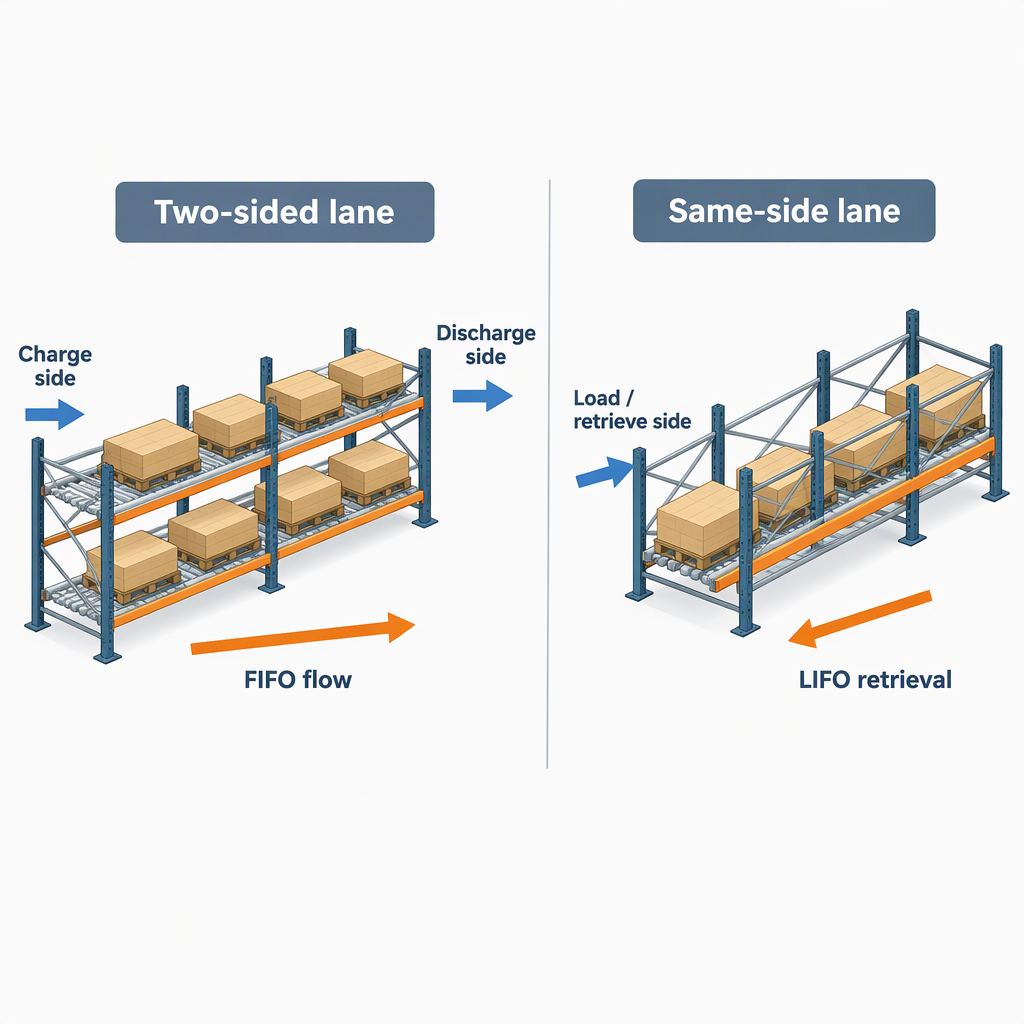
Conceptual warehouse lanes showing FIFO flow-through movement and LIFO same-side retrieval

FIFO vs. LIFO storage: the layout difference

FIFO means the first pallet stored is the first pallet retrieved, so the rack layout must create a clear storage-to-pick sequence. LIFO means the most recently stored pallet is retrieved first, so the layout can use same-side loading and unloading when inventory rotation allows it.

FIFO layout logic

A FIFO layout is strongest when date control, lot rotation, or high turnover makes pallet sequence important. The planning question is whether the rack gives the older pallet a reliable path to retrieval before newer pallets block it.

LIFO layout logic

A LIFO layout is strongest when pallets are homogeneous and value or quality is not harmed by retrieving the newest pallet first. The planning question is whether density gains outweigh the reduced natural rotation.

In high-density rack planning, this difference often appears as pallet flow versus pushback: pallet flow moves pallets from a charge side toward a discharge side, while pushback stores and retrieves pallets from the same aisle side.

FIFO-friendly layouts: selective, pallet flow, and drive-thru

Common FIFO rack styles include single selective, pallet flow, and drive-thru layouts, each trading density, access, and operating discipline in a different way.

Single selective pallet racking

Selective racking gives direct access to stored pallets, which helps when the operation needs SKU access and straightforward rotation control rather than maximum lane density.

Pallet flow racking

Pallet flow supports FIFO by loading pallets from one side and retrieving them from the opposite side, but it requires attention to pitch, pallet quality, and operator training.

Drive-thru racking

Drive-thru layouts can support FIFO because lift trucks can access the lane from both sides, but the operation must manage batch equivalence, access discipline, and potential honeycombing.

LIFO-friendly layouts: double-deep, pushback, and drive-in

Common LIFO rack styles include double-deep selective, pushback, drive-in, and double-wide drive-in layouts, all of which can increase storage density while reducing natural first-in rotation.

Double-deep selective

Double-deep selective storage places one pallet behind another, so access is less direct than single selective storage and the newest accessible pallet may be picked first.

Pushback racking

Pushback racking stores pallets in a lane from the aisle side and retrieves them from that same side, making it a natural LIFO choice where date rotation is less critical.

Drive-in and double-wide drive-in

Drive-in styles can suit homogeneous inventory where lane density is valuable, but the operation must account for selectivity, honeycombing risk, and operator skill requirements.

Pallet flow vs. pushback: where the rule changes the rack

Choose pallet flow when the inventory rule requires charge-side to discharge-side FIFO movement. Choose pushback when same-side storage and retrieval can follow a LIFO rule without harming the inventory plan.

Decision field Pallet flow Pushback
Inventory rule Supports FIFO movement from charge side to discharge side. Supports LIFO retrieval from the same aisle side.
Access pattern Typically needs separate loading and unloading sides. Uses one aisle face for loading and retrieval.
Operational fit Useful when rotation sequence matters and pallets can flow reliably. Useful when dense lane storage is acceptable and newest-first retrieval is acceptable.
Planning cautions Check pallet quality, pitch, brakes or speed controllers, structural obstructions, honeycombing, and fire-protection consultation needs. Check lane depth, pallet condition, honeycombing, lift-truck interaction, structural obstructions, and fire-protection consultation needs.

For an industry explanation of this distinction, see the RMI Safety comparison of pallet flow and pushback rack systems.

Match the rack to SKU mix, date codes, and pallet quality

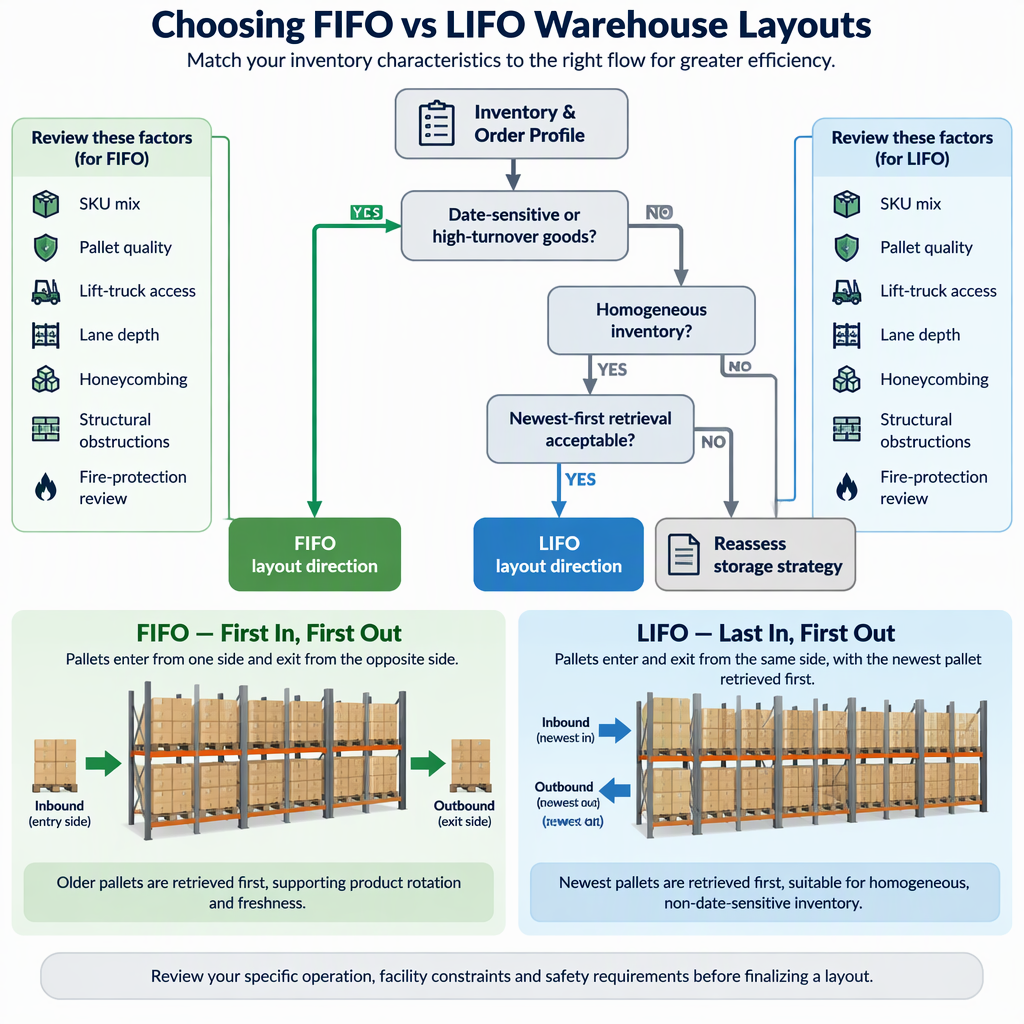
FIFO layouts suit time-sensitive or high-turnover goods when the operation must keep older pallets moving first. LIFO layouts suit homogeneous inventory where expiration or value decay is less critical.

Decision flow for choosing FIFO or LIFO racking based on rotation need, SKU mix, pallet quality, equipment, and review gates
Inventory or operating condition What it suggests Buyer check before shortlist
Date-sensitive, lot-controlled, or high-turnover inventory Favor FIFO-friendly layouts such as selective access, pallet flow, or drive-thru where the retrieval path supports rotation. Confirm whether the oldest pallet remains visible, reachable, and prioritized in normal operating conditions.
Homogeneous goods with low risk from newest-first retrieval Consider LIFO-friendly layouts such as double-deep, pushback, or drive-in when density matters. Confirm that pallets in each lane are interchangeable enough to prevent lot or service conflicts.
Variable pallet quality or pallet condition concerns Be cautious with dynamic systems that depend on predictable pallet movement. Ask the rack supplier to review pallet dimensions, condition, weights, and contact surfaces for the specific design.
High SKU variety or weak batch equivalence Avoid deep lanes that turn into unusable honeycombed space. Group lanes by SKU, batch, or turnover profile before comparing density claims.

Where a dynamic lane is considered, planners should also include lift-truck access, structural obstructions, lane depth, and fire-protection consultation in the design review rather than treating the inventory rule as the only criterion.

Design checks before layout approval

Before approving a high-density FIFO or LIFO layout, check the physical lane behavior, pallet compatibility, equipment access, operator skill requirements, honeycombing risk, structural obstructions, and fire-protection review path.

  1. Start with the inventory rule: identify which SKUs require FIFO rotation and which can tolerate LIFO retrieval.
  2. Group SKUs by turnover, lot control, date sensitivity, and batch equivalence before assigning them to lane depths.
  3. Check pallet quality and consistency, especially where pallet flow, pushback, pitch, brakes, or speed controllers affect movement.
  4. Match lift-truck access and operator skill to the rack style, especially for deeper or drive-in configurations.
  5. Review structural obstructions, lane depth, honeycombing exposure, and fire-protection consultation needs before finalizing the layout.

Procurement checklist for FIFO or LIFO racking

A useful racking request should describe the inventory rule, SKU behavior, pallet data, handling equipment, building constraints, and review requirements clearly enough for suppliers to propose a layout rather than a generic rack type.

  • State which SKUs require FIFO storage and why, including date sensitivity, turnover, or lot-rotation requirements.
  • State which SKUs may use LIFO storage because the inventory is homogeneous and newest-first retrieval is acceptable.
  • Provide pallet dimensions, pallet condition expectations, load characteristics, and any pallet-quality constraints that affect dynamic rack behavior.
  • Provide SKU counts, pallets per SKU, turnover rates, and batch-equivalence assumptions so the supplier can test selectivity and honeycombing risk.
  • Describe lift-truck types, aisle constraints, building columns or other structural obstructions, and required loading or retrieval sides.
  • Ask how the proposed rack addresses lane depth, brakes or speed controllers where relevant, operator training, and fire-protection consultation.
  • Request project-specific drawings, load data, applicable compliance documents, and maintenance guidance from the supplier before purchase approval.

Use supplier pages as starting points, not specifications

The homepage associated with 江苏六维智能物流装备股份有限公司 lists categories such as AS/RS system, selective pallet racking, drive-in pallet racking, radio shuttle pallet racking, gravity pallet racking, push back racking, flow through racking, and related logistics equipment.

Conclusion: choose the rack that enforces the rule

If the operation must protect first-in rotation, shortlist FIFO-friendly layouts first. If inventory is homogeneous and newest-first retrieval is acceptable, LIFO-friendly layouts can be considered for density.

The final layout should be the one that makes the correct pallet the easiest pallet to retrieve while still satisfying pallet quality, lane depth, equipment access, structural, honeycombing, and fire-protection review needs.

  • FIFO decisions should begin with rotation requirements, not rack density alone.
  • LIFO decisions should be limited to inventory that can tolerate newest-first retrieval.
  • Pallet flow and pushback are similar high-density concepts, but the inventory rule changes the access pattern.

FAQs about FIFO vs. LIFO storage layouts

These questions help warehouse planning, logistics operations, and engineering procurement teams turn the FIFO vs LIFO storage comparison into a practical racking shortlist.

What is the main layout difference between FIFO and LIFO storage?

FIFO layouts help the first-loaded pallet become the first pallet retrieved. LIFO layouts allow the newest loaded pallet to be retrieved first when the inventory profile permits it.

Which rack types are commonly associated with FIFO?

RMI identifies single selective, pallet flow, and drive-thru as common FIFO rack styles, each with different trade-offs in density, access, pitch, honeycombing, and operator discipline. For more detail, see RMI Safety’s overview of FIFO rack systems.

Which rack types are commonly associated with LIFO?

RMI identifies double-deep selective, pushback, drive-in, and double-wide drive-in as common LIFO rack styles. Its discussion of LIFO rack systems also highlights trade-offs in equipment, selectivity, honeycombing, and operator skill.

When should pallet flow be preferred over pushback?

Prefer pallet flow when the warehouse needs charge-side to discharge-side FIFO movement. Prefer pushback when same-side loading and retrieval can follow a LIFO rule without creating rotation problems.

Can a dense rack layout still protect inventory rotation?

It can, but only if the lane behavior supports the required retrieval sequence and the design accounts for lane depth, pallet quality, honeycombing, and fire-protection consultation. For strict rotation, FIFO-friendly layouts should be assessed before dense LIFO options.

Why does homogeneous inventory matter in LIFO storage?

Homogeneous inventory reduces the risk that retrieving the newest pallet first will leave the wrong lot, date, or SKU trapped behind newer pallets, which is why LIFO layouts fit better where expiration or value decay is less critical.

What should procurement prepare before asking for a quotation?

Prepare pallet data, lane-depth expectations, building constraints, lift-truck information, and fire-protection review requirements. Also define which SKUs require FIFO rotation. Separate any SKUs that can tolerate LIFO storage.

Can a supplier homepage prove that a rack category fits my project?

No. A homepage category list can help you find the right discussion topic, but project fit still depends on the specific SKU profile, pallet data, drawings, design assumptions, and supplier documentation for the proposed system.

China : +86-13705159108

US: +1 269 830 5802

MY:+60 126162998

China : Floor 9, Building 1, Zijinxicheng Center, No. 118 Olympic Gym Str., Jianye, Nanjing, Jiangsu, China 


US: 3702 W Sample Street,South Bend,Indiana,46619  

China:export@nova-china.com 
 
US: Bin@nova-china.com
 
MY:nct@nova-china.com

Quick Links

Products

 Copyrights 2019 NOVA All rights reserved. Sitemap
Technology by Leadong