
 English


SKU proliferation changes warehouse storage requirements by increasing the variety of storage locations, pick faces, reserve rules, and assignment decisions the operation must manage; it is not simply a request for more total positions.
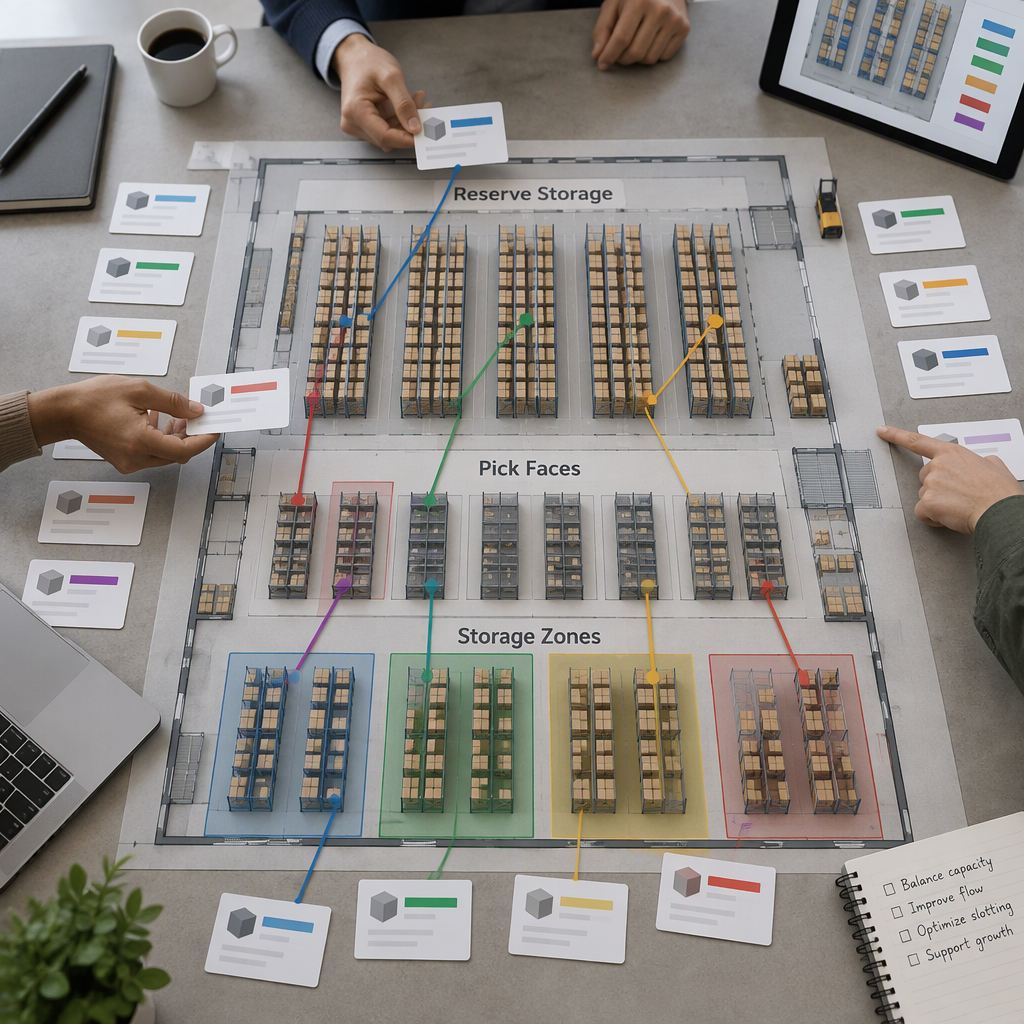
How SKU proliferation changes warehouse storage requirements
As the SKU base grows, storage planning shifts from a capacity question to an assignment problem: each item needs a suitable location type, access pattern, replenishment rule, and relationship to other items in the pick path.
The storage location assignment literature review describes storage location assignment as a complex warehouse-management decision involving product volume, demand uncertainty, service expectations, and efficient allocation of storage spaces.
- A higher SKU count usually increases the number of item profiles that must be classified before slotting decisions are made.
- The planning problem becomes more sensitive to demand uncertainty, because slow movers, seasonal items, and fast movers compete for accessible locations.
- Storage media, location assignment, and operating rules should be reviewed together rather than treated as separate procurement decisions.
Start with the SKU data that drives storage decisions
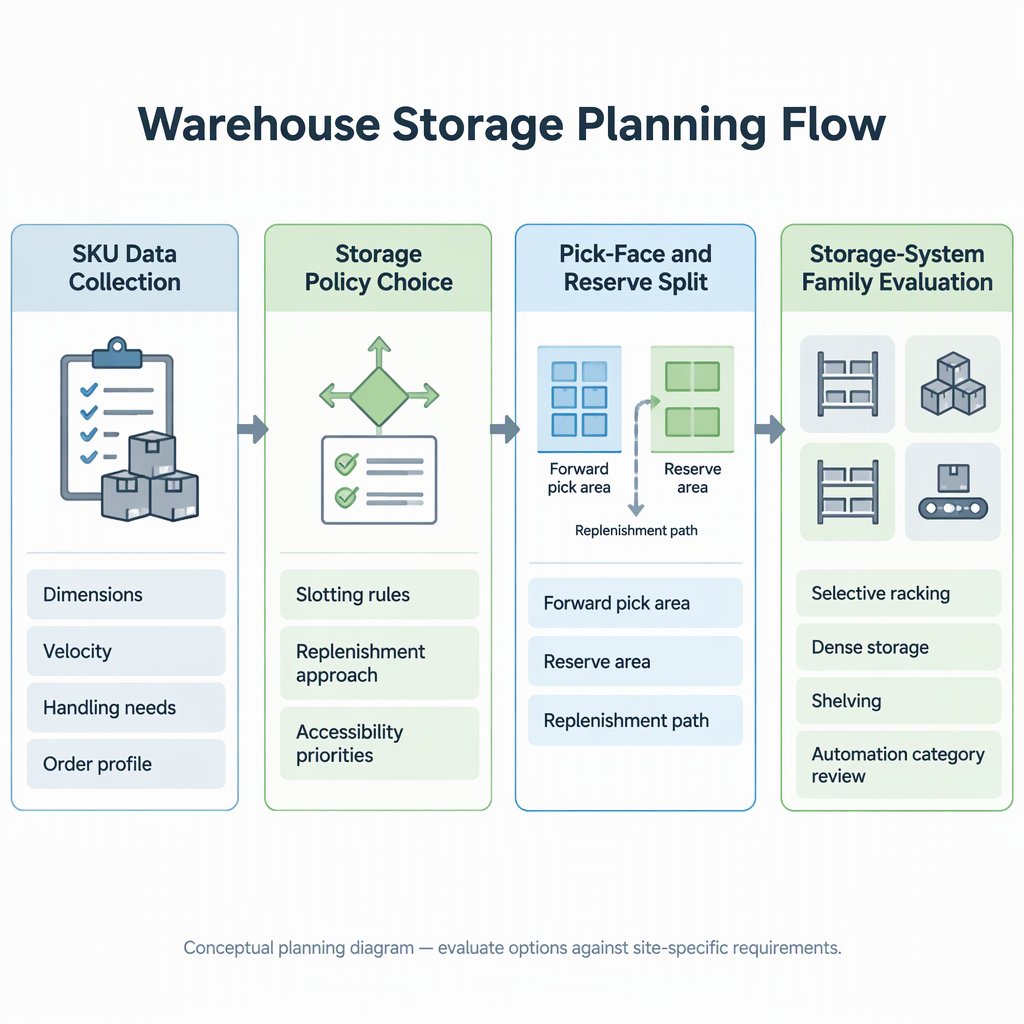
Before changing racking or storage media, planners should classify SKUs by demand, handling unit, dimensions, replenishment behavior, and service priority so that locations are assigned by operating need rather than by item count alone.
- Separate pallet, carton, case, and each-pick SKUs, because each profile may need a different pick-face and reserve-storage relationship.
- Group SKUs by velocity and demand variability, not only by product family, so that access-sensitive items are not hidden behind slow movers.
- Record cube, weight, stackability, handling constraints, and packaging changes that affect the physical location type.
- Identify seasonal or promotional SKUs that may need temporary overflow or more flexible assignment rules.
- Compare order-line frequency with stockholding volume to avoid giving too much prime pick space to bulky items with low picking activity.
Map the effect on slotting, pick faces, and travel paths
SKU growth affects picking because storage assignment and picker routing interact; when more SKUs compete for forward locations, the warehouse must decide which items deserve pick-face space and how often reserve stock will replenish them.
- Map the current pick path and identify where added SKUs would create longer travel, more aisle changes, or more congestion.
- Define forward-pick candidates from order-line activity, not from inventory volume alone.
- Separate items that need stable pick faces from items that can move under a more dynamic storage rule.
- Check whether replenishment work will rise when many low-volume SKUs receive small forward locations.
- Review storage assignment and routing together; the storage location assignment and picker routing problem connects location decisions with order-picking performance and more dynamic warehouse operation.
Buyer note: a layout that looks dense on a drawing can still perform poorly if it creates excessive travel, frequent replenishment interruptions, or unclear rules for where new SKUs are placed.
Choose the storage policy before choosing equipment
The storage policy should be selected before equipment because dedicated, shared, class-based, and dynamic assignment rules create different requirements for location count, accessibility, system control, and operator discipline.
| Policy choice | Best-fit planning condition | Storage requirement impact |
|---|---|---|
| Dedicated locations | Useful when items need stable locations for recognition, handling control, or predictable replenishment. | Requires enough fixed positions for the assigned SKU set and may leave space underused when demand shifts. |
| Shared locations | Useful when SKUs change often and the warehouse can control inventory accuracy and location records. | Can increase location flexibility but depends on disciplined assignment and search control. |
| Class-based storage | Useful when SKUs can be grouped by velocity, handling profile, or service priority. | Requires zones sized around item classes rather than one uniform location rule. |
| Dynamic storage | Useful when the SKU mix changes frequently and operating systems can guide placement and retrieval. | Requires stronger process control and clearer rules for location assignment and pick execution. |
Do not select storage media only from a SKU-count target. First define whether the operation needs stability, flexibility, class zoning, or dynamic control; then compare physical systems against that policy.
Recheck reserve storage and replenishment pressure
SKU proliferation can increase the number of reserve locations and replenishment decisions even when total inventory does not grow at the same rate. It can also make daily storage decisions more dynamic when pick locations and routes must adapt to changing order profiles.
- Split the SKU base into forward-pick, reserve-only, overflow, and exception-handling groups.
- Check whether each forward location has an appropriate reserve source and a practical replenishment trigger.
- Review whether replenishment travel interferes with picking travel, especially where order-picking routes pass through the same aisles.
- Plan for new-SKU intake, obsolete-SKU removal, and temporary promotions so that reserve areas do not become unmanaged overflow.
- Use dynamic assignment only where the warehouse can keep accurate location records and guide operators to the correct stock.
Compare storage-system families against the SKU profile
A growing SKU base often needs a mix of storage families rather than one uniform rack type. Supplier product-category pages may include examples such as AS/RS storage solutions, shuttle systems, selective pallet racking, drive-in or drive-through racking, VNA racking, and multi-tier racking support mezzanine floor.
| Storage-system family | SKU-profile question | Buyer evaluation focus |
|---|---|---|
| Selective pallet racking or heavy-duty pallet racking | Do many SKUs need direct pallet access? | Compare accessibility, aisle strategy, location count, and reserve-to-pick relationship. |
| Drive-in or drive-through pallet racking | Are there SKU groups with deeper storage and fewer access points? | Check whether depth, batch profile, and rotation rules match the actual SKU mix. |
| VNA racking | Is floor-space pressure high while individual pallet access remains important? | Review aisle equipment, traffic rules, and selectivity needs before focusing on density. |
| Shuttle or AS/RS storage solutions | Does the operation need more controlled, system-guided storage and retrieval for changing SKU demand? | Evaluate control requirements, order profile, replenishment logic, and integration needs. |
| Mezzanine, platform, flow-through, push-back, cantilever, rack-supported building, or logistics-equipment categories | Do certain SKUs have handling, shape, flow, or building-envelope requirements that do not fit standard pallet storage? | Match the family to the handling profile and confirm project-specific specifications with the supplier. |
Product-category names are only a starting point. Project suitability depends on engineered dimensions, load requirements, handling equipment, inventory profile, fire and building constraints, and supplier-confirmed specifications.
Turn the analysis into an RFQ checklist
An RFQ for a high-SKU warehouse should ask suppliers to respond to storage-assignment requirements, not only rack quantities. It should also address how storage choices affect picking, routing, and replenishment execution.
- Provide the SKU master, forecasted SKU growth, handling-unit split, item dimensions, weights, and rotation requirements.
- Ask the supplier to separate forward-pick, reserve, overflow, and exception-storage assumptions.
- Request a layout explanation that shows pick paths, replenishment paths, and operational control points.
- Ask which storage policy the design assumes: dedicated, shared, class-based, dynamic, or a hybrid.
- Require project-specific drawings, load assumptions, location counts, and operating limitations instead of relying on general product-category descriptions.
- Ask how future SKU introductions and removals would be handled without disrupting picking accuracy.
Conclusion
SKU proliferation should trigger a storage-requirements review that starts with item data, storage policy, and location assignment. The review should then test how those decisions affect picking routes, replenishment pressure, and day-to-day control.
For warehouse planning managers, logistics operations teams, and engineering procurement, the practical next step is to convert SKU growth into a documented location strategy before comparing equipment families. That approach keeps the buying discussion focused on access, flexibility, reserve logic, and operating control rather than on a single density target.
FAQs
The most useful SKU storage requirements questions focus on location assignment, pick-face pressure, reserve rules, and the evidence suppliers need to design a suitable system.
Does SKU proliferation always require more warehouse space?
Not always. SKU growth may require more location types, more pick faces, or different assignment rules before it requires a larger building footprint.
Why can a small-volume SKU create a storage problem?
A small-volume SKU can still consume valuable pick-face space, require special handling, or add location-management complexity if it appears frequently in orders.
When should a warehouse use class-based storage?
Class-based storage is useful when SKUs can be grouped by velocity, handling profile, or service priority, allowing each class to receive a suitable zone and access rule.
How does SKU growth affect picker travel?
As more SKUs compete for locations, pick paths can become longer or less predictable unless storage assignment and routing are planned together.
Should slow-moving SKUs stay in the forward-pick area?
Only when their order activity, handling need, or service priority justifies the forward location. Otherwise, they may be better managed in reserve or exception storage with clear replenishment rules.
Can one rack type handle every SKU-growth scenario?
A single rack type may fit some operations, but a growing SKU base often requires comparing multiple storage-system families and confirming the final design against project-specific SKU data.
What should procurement avoid when requesting quotes?
Procurement should avoid asking only for rack quantities. A stronger RFQ explains SKU profiles, storage policy, pick-face assumptions, reserve strategy, and future SKU-change requirements.


