
 English


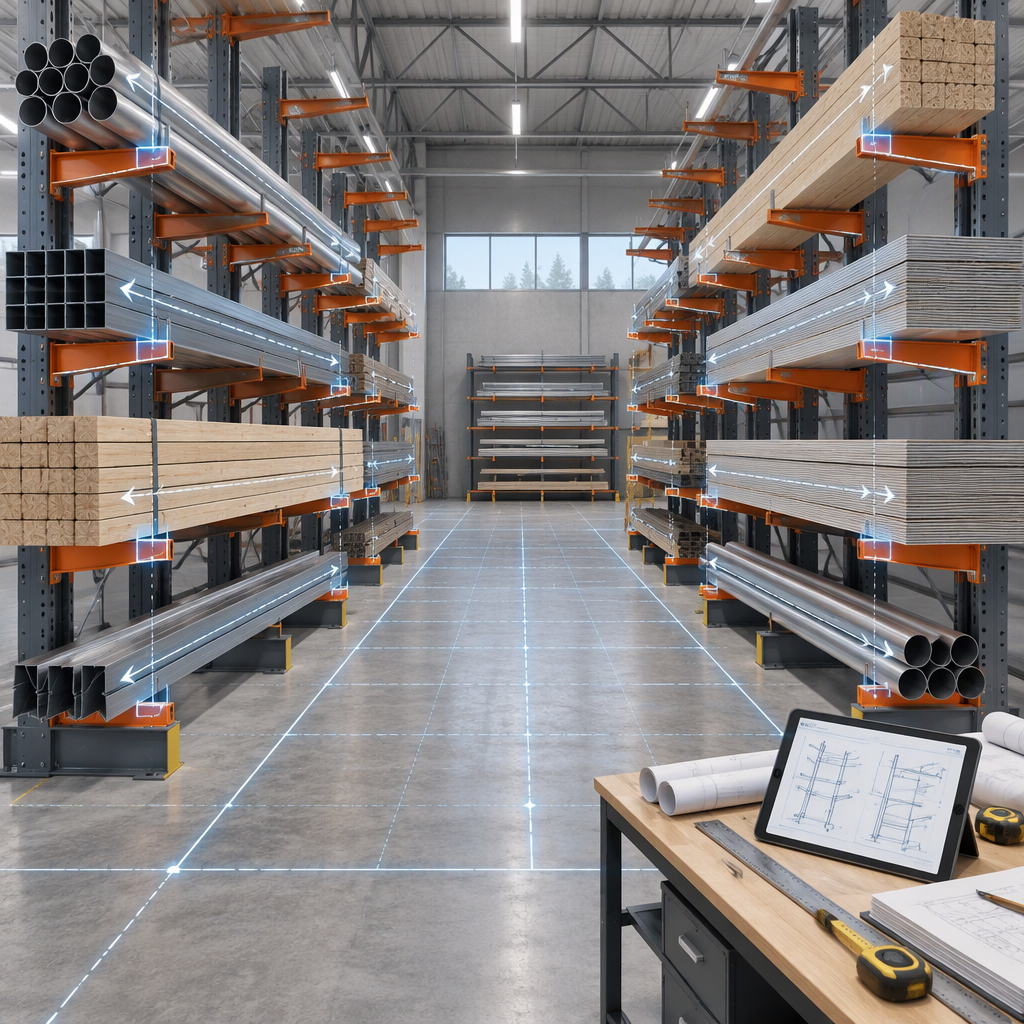
Define the long-load profile before specifying rack components
Start with the load, not the rack: cantilever racks are used for long, bulky, or irregular loads such as lumber, tubing, pipe, and sheet goods, which are supported on arms extending from upright columns.
- List the material families to be stored: pipe, tube, timber, bar stock, profiles, panels, sheet goods, or mixed long materials.
- Record the maximum and typical length, bundle width, bundle height, unit weight, and the way each load is strapped, nested, stacked, or separated.
- Define how the load will sit across the arms, including whether normal handling may place the material slightly off center.
- Identify the handling equipment, aisle approach, lift height, and whether operators load one side or both sides of an aisle.
- Include the longest expected load and the heaviest expected load as separate checks; they may not be the same item.
- Separate rigid bundles from flexible or sagging materials, because support-point decisions can differ.
- State whether loads are picked individually, in bundles, or by pallet-like carriers.
- Ask the supplier or engineer to base the proposal on your stated load cases, not on a product-category description alone.
Specify load placement, center of gravity, and support points
Long-load placement matters because off-center material can change how force is shared by cantilever arms; RMI notes that ANSI MH16.3-2025 added product-load guidance with centered and off-center loading examples.
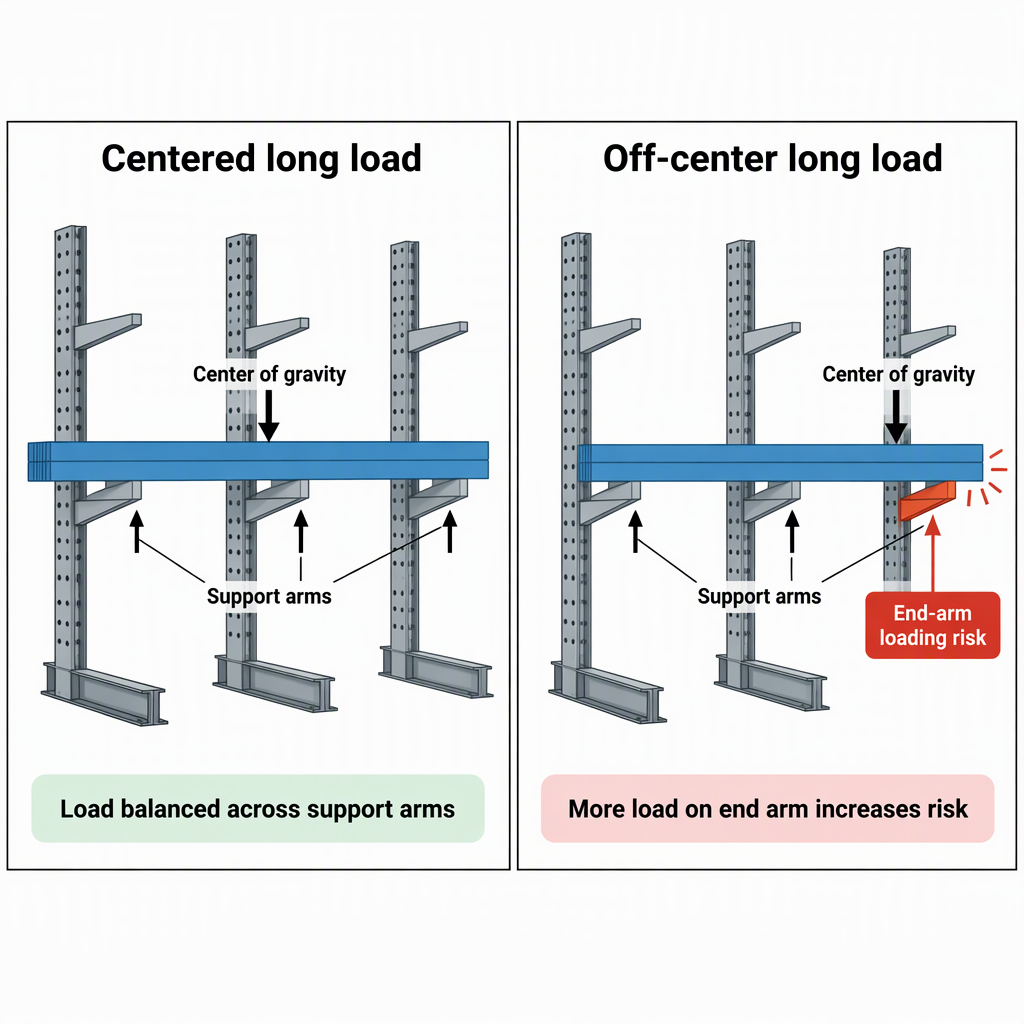
Do not treat a centered load diagram as proof that real warehouse loading will always be centered. If operators can place long items unevenly, specify the expected placement tolerance and ask how the end arms are evaluated.
The Rack Manufacturers Institute summary of ANSI MH16.3-2025 explains that the updated standard includes product-load guidance, arm-force differences, and examples in which an off-center long item can overload an end arm and should be recentered.
For procurement, this means the RFQ should describe more than total bundle weight. It should define the number of arms supporting each load, the minimum bearing length on each arm, whether loads may overhang, and whether mixed-length inventory will share the same rack bay.
Turn the load profile into engineering assumptions
Ask for a design basis tied to ANSI MH16.3-2025 or the applicable project standard, because the current RMI summary describes the standard as a framework for design and evaluation of industrial steel cantilever storage racks.
| Buyer input | Why it belongs in the specification | What to request |
|---|---|---|
| Centered and off-center load placement | Long loads can shift force toward an end arm when placed unevenly. | Load-placement assumptions and handling tolerance used in the rack design. |
| Seismic, anchorage, slab, and stability conditions | RMI reports that ANSI MH16.3-2025 updates seismic provisions, stability analysis, column-to-base design, and baseplate or anchor requirements. | Project-specific engineering review of base, anchor, and stability assumptions. |
| Installation and post-installation checks | The design intent needs to be confirmed before the system is placed into service. | Inspection scope, commissioning checks, and responsible engineering sign-off. |
Where seismic exposure, floor anchorage, baseplate design, or column stability is material to the project, request engineering documentation rather than relying on a catalog image or a single arm-capacity statement.
Choose the configuration around access and load behavior
Configuration should follow material access, load length, and support behavior: cantilever rack arms are suited to materials that need open-front storage rather than closed pallet positions.
| Configuration question | When it may fit | Buyer caution |
|---|---|---|
| Single-sided rows | Wall-side storage, perimeter aisles, or layouts where access is needed from one side only. | Confirm upright, base, and anchor assumptions for the one-sided loading condition. |
| Double-sided rows | Central aisles where operators need access from both sides and inventory turns justify the footprint. | Do not assume both sides carry identical loads unless the specification says so. |
| Fewer support points for long material | May reduce obstruction for handling long items. | Confirm that the remaining arms support the load without unacceptable end-arm concentration. |
| More support points for flexible material | May help support bundles or materials that sag between arms. | Confirm the intended arm spacing and load placement assumptions before purchase. |
A layout that looks efficient on a plan can still be a poor fit if operators cannot place the load consistently, if aisle approach is awkward, or if mixed lengths cause frequent overhang. Treat the rack layout, handling method, and load assumptions as one buying decision.
Plan installation, inspection, and operating controls
Plan verification before use: RMI reports that ANSI MH16.3-2025 clarifies installation and post-installation inspection expectations, including engineer-of-record verification of design intent before commissioning.
- Request an installation and inspection plan that identifies which elements need inspection before the rack is put into service.
- Confirm that baseplates, anchors, slab interface, and stability assumptions are covered where they affect the project.
- Coordinate rack placement with warehouse handling, site transport, working-at-height, and general hazard-control practices.
- Train operators on the approved load orientation, maximum load cases, and recentering expectations for long items.
For broader warehouse safety context, the UK Health and Safety Executive’s Warehousing and storage: A guide to health and safety addresses responsible warehouse practices, avoidable risks, mechanical handling, site transport, and working at height.
Use an RFQ checklist that separates verified requirements from assumptions
A practical RFQ should state your load cases and documentation needs, then ask suppliers to respond with the cantilever rack configuration, engineering basis, and inspection information that match those inputs.
| RFQ item | Include in the buyer’s request | Ask the supplier to return |
|---|---|---|
| Load type | Pipe, tube, lumber, profiles, sheet goods, or other long/irregular materials. | Recommended rack type, arm layout, and storage orientation. |
| Load placement | Centered, off-center tolerance, overhang, support-point count, and recentering expectations. | Design assumptions used for arm forces and supported load cases. |
| Design framework | Applicable cantilever rack standard or project engineering requirement. | Design documentation appropriate to the project and location. |
| Installation verification | Commissioning, inspection scope, and handover documentation expectations. | Installation drawings, inspection checklist, and responsibility matrix. |
- If you are considering NOVA, its English product center includes a Cantilever Storage Racks category.
- Ask any supplier for project-specific drawings, allowable load assumptions, installation requirements, and maintenance guidance.
- Do not substitute marketing descriptions for engineered load cases, site conditions, or commissioning checks.
- Keep price and lead-time comparison separate from structural suitability until the technical response is complete.
Conclusion
The safest buying path is to specify the long load clearly, require centered and off-center placement assumptions, and make installation verification part of the purchase requirement.
- Use cantilever racking where long, bulky, or irregular materials need open-arm support.
- Define center-of-gravity and support-point assumptions before comparing rack proposals.
- Include installation and post-installation inspection expectations before commissioning.
- Coordinate the rack decision with warehouse handling and operating controls.
FAQs about specifying cantilever racking for long loads
Buyers usually need answers about load definition, placement tolerance, configuration, engineering review, installation checks, and supplier documentation before issuing a purchase order.
What loads are cantilever racks typically used for?
They are commonly used for long, bulky, or irregular loads such as lumber, tubing, pipe, and sheet goods that can be supported on arms from upright columns.
Why does center of gravity matter for long loads?
Because an off-center long item can concentrate force on an end arm, buyers should define placement tolerance and support points rather than assuming perfect centering.
Can I buy from a generic capacity chart?
Use capacity information only with the applicable design basis, load cases, and site assumptions; ANSI MH16.3-2025 is described by RMI as a framework for design and evaluation of industrial steel cantilever storage racks.
Should I choose single-sided or double-sided cantilever rack?
Choose single-sided storage for one-way access or perimeter rows, and consider double-sided rows where central-aisle access and inventory flow justify it. In both cases, ask for the loading assumptions used in the design.
What should be checked before the rack is used?
Plan post-installation inspection and confirmation of design intent before commissioning, including the elements identified by the responsible engineer.
How does warehouse operation affect the rack specification?
Handling equipment, site transport, working at height, and general hazard control influence how long loads are stored and moved, so they should be considered with the rack layout.
What should I ask a supplier to provide?
Ask for drawings, stated load cases, centered and off-center placement assumptions, arm and upright configuration, anchorage assumptions, installation instructions, inspection scope, and any project-specific engineering documentation.


