(+86)-025-86106536 (+86)-13705159108

 English
- All
- Product Name
- Product Keyword
- Product Model
- Product Summary
- Product Description
- Multi Field Search
Views: 0 Author: Site Editor Publish Time: 2026-11-24 Origin: Site
A warehouse automation proposal becomes comparable only when every offer is rewritten onto one baseline — same demand, building, interface boundary and division of supply — and priced in equipment, delivered-and-commissioned and lifecycle layers. The lowest equipment line rarely survives; a bid's omissions are what you pay for later.
Because a price means nothing until the offers cover the same work. Write one baseline — storage and throughput demand, building and fire constraints, interfaces, and who supplies what — issue it as an RFQ annex, and score scope before opening the envelope.
Ask every bidder for a written scope statement in identical wording. Planning, design, manufacturing, installation, commissioning, and after-sales support with maintenance form one complete declared scope; a bid that quietly omits a stage is incomplete, not cheaper.
Any line marked by others, customer supply, or to be agreed is a blank price. Cost those lines yourself from your own contractors and specialist trades before comparing totals, and keep the estimate next to the offer.
Settle who keeps the equipment maintained in an efficient state and in good repair after handover, who keeps the maintenance log up to date, and whether the proposal brings a schedule built on the manufacturer's maintenance instructions together with the training to carry that work out.
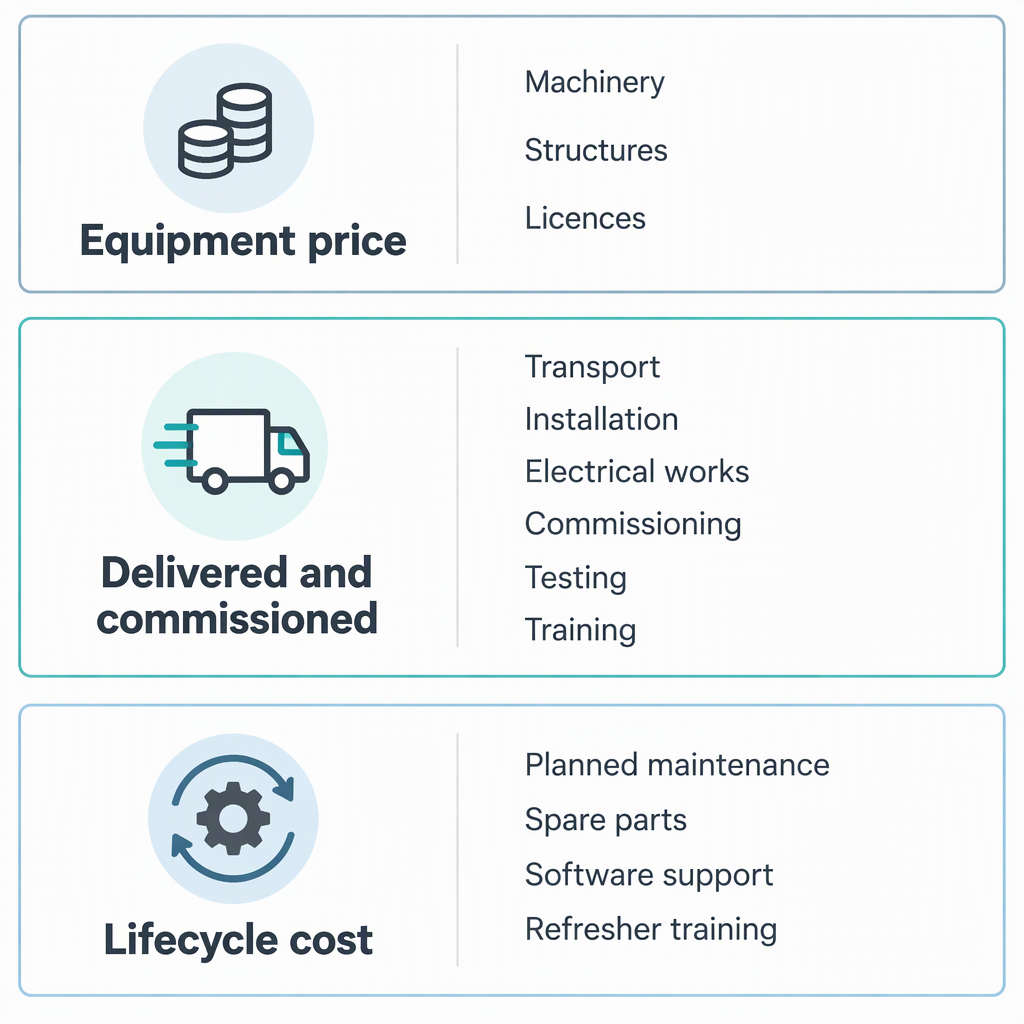
Three layers: the equipment price, the delivered and commissioned price, and the lifecycle price for the term you intend to run the system. Require all three from every bidder in the same template, and keep the equipment figure visible only as a breakdown inside that template.
Cost layer | What belongs in it | What to require with the proposal |
|---|---|---|
Equipment price | Racking, machines, robots, conveyors, controls hardware and software licences as itemised lines | Itemised bill of materials with quantities, model references and the unit each line is priced in |
Delivered and commissioned | Transport, installation, mechanical and electrical works, commissioning and testing, operator training — every stage between delivery and a system running to the agreed baseline | One delivered-and-commissioned price for the declared scope, with the build-up shown so that missing stages become visible |
Lifecycle | Planned maintenance built on the manufacturer's maintenance instructions, spare parts, repairs, software support and version updates, refresher training | A support schedule for the contract term stating cover hours, parts basis, response targets and exactly what the fee includes |
Fill all three layers for the depreciation period; an incomplete cell means a line is excluded or unpriced, and both need a number before you compare totals.
Test fit against data you control rather than against the specification sheet: your unit loads, your rate profile, your building, your interfaces and the tasks your operators keep. A short technical checklist answered identically by every bidder exposes the offers that would only work if your operation changed to suit them.
Great Britain's Health and Safety Executive treats risk assessment and machine choice as linked steps: understand the hazards and operating reality first, then judge the machine.
Unit loads: dimensions, weight, stability, packaging and the temperature at which goods arrive and leave.
Rate profile: average and peak movements per hour by day and by season, and how those peaks are absorbed today.
Storage requirement: pallet or tote positions by product family, plus the growth you must absorb without a rebuild.
Building: clear height, floor levelness and flatness tolerance, column grid, dock positions, fire compartmentation and escape routes.
Environment: ambient temperature range, dust, humidity, washdown, and any food, pharmaceutical or cold-chain constraint.
Interfaces: what the system must send and receive, and which system holds the master data for each item.
People: which tasks stay manual, and what happens on the floor when the automation is unavailable.
Split the software answer into standard functions, site configuration and project development, then fix the interface: who writes it, to which specification, how it is tested, and what happens when versions change. For mobile robots, the VDA publishes VDA 5050 Version 3.0.0, a communication interface for exchanging order and status data between a central fleet control and the robots in intralogistics.
The VDA 5050 specification text and JSON schemas are openly published, with the publisher's PDF named as the authoritative document. Ask which version a vendor implements, and whether version upgrades sit inside the support fee or arrive as a paid project later.
VDA 5050 addresses order and status exchange between fleet control and mobile robots. It does not standardise your slotting, order release or warehouse control logic, so those remain project scope that someone must own.
Name the party that writes the host interface, the party that tests it end to end, and the test environment both will use before go-live.
Agree the licence model — per robot, per site, per user, or per transaction — and how it behaves as your fleet, shifts or volumes grow.
Confirm who owns master data, transaction logs and the interface documentation after handover.
Fix the scoring sheet before any offer is opened: named criteria, weights agreed by operations and finance, and a rule for what counts as evidence. Score written answers rather than presentations, and use the total to structure the final round of questions instead of ending the discussion.
Criterion | What you score | Evidence you accept | Weight (set by you) |
|---|---|---|---|
Scope completeness | How much of the baseline is covered with no open items | Signed line-by-line response to the baseline annex | Agreed before opening offers |
Technical fit | Whether the quoted equipment handles your loads, rates and building | Load data, rate calculations, layout drawings | Agreed before opening offers |
Software and interfaces | Standard versus configured versus project work, and interface ownership | Function list, interface specification, test plan | Agreed before opening offers |
Implementation and acceptance | Dates, dependencies and pass criteria | Schedule with milestones, acceptance protocol | Agreed before opening offers |
Lifecycle support | Cover for the term, from response to repair | Support schedule, parts basis, escalation path | Agreed before opening offers |
Safety and compliance documents | Whether the applicable documents exist and are specific to your site | Declarations, risk assessment, maintenance instructions | Pass or fail, not weighted |
Commercial terms | Three cost layers, payment schedule and price adjustment | Completed cost template, stated terms | Agreed before opening offers |
Comparable experience | What the bidder can describe from installations like yours | Written project descriptions they will discuss with you | Agreed before opening offers |
Freeze baseline revision 1.0 and issue it as an annex with a fixed response template.
Set criteria, weights and pass-or-fail gates in one session with operations, engineering and finance.
Require written answers in the template, and return incomplete responses instead of scoring them.
Score each bid independently by two reviewers, then reconcile differences against the written evidence.
Test the result by doubling the weight of the criterion you trust least and checking whether the ranking holds.
Hold clarification meetings only after scoring, with questions drawn from the lowest-scoring cells.
Record the weights, scores and reasons for any override, so the choice can be explained to anyone who asks later.
Dates, dependencies, tests, documents, training and named sign-offs — all written into the contract before work starts. Acceptance tested against your baseline, covering functions, operating conditions, safety documentation and training, is what stops the final payment from becoming a second negotiation.
Site readiness: building works, floor preparation, power, network and compressed air, with the date the supplier needs each one.
Freeze dates for layout, interface specification and the software function list, plus a written change process for anything that moves.
A test plan naming the functions and loads to be proven, the conditions, the pass criteria and who witnesses each test.
Training that covers the maintenance tasks your own team will take on, including the safe isolation step before any intervention, with competence signed off rather than sessions counted.
A documented quality plan you can read: raw-material, first-piece and in-process inspection, welding and coating parameters, packing and factory checks. One supplier publishes exactly that and cites Chinese rack design code CECS 23:90 and seismic code GB 50011-2010; ask each bidder for the equivalent, the code edition and the local amendments.
Documentation handover: as-built drawings, electrical schematics, spare-parts list, operating manuals and maintenance instructions.
Retention or defect security, and precisely what has to be proven before it is released.
Normalise support onto fields every bidder must fill: hours of cover, response and repair targets by fault severity, who attends, where parts are held, and what the annual fee includes. Whoever operates the system then has to keep the equipment in an efficient state and in good repair, with a maintenance log kept up to date, so the proposal must show a schedule built on the manufacturer's maintenance instructions and the competence to deliver it. A supplier that declares installation, commissioning and after-sales support in one scope gives you a single party to hold to that schedule.
Response and repair targets by severity, not one headline number
Covered hours, including weekends and peak trading periods
Who attends — your team, the supplier's engineers, or a subcontracted third party
Where the parts sit, and the lead time for long-lead items
What the fee includes, and what is invoiced on top
Which parts are recommended on site and which the supplier holds locally
Price basis for parts, and whether it is fixed or indexed over the term
The obsolescence plan for controls, drives and robots as models change
Whether rebuilt or equivalent parts are permitted, and who warrants them
Round-the-clock cover with no severity bands, no attendance target and no remedy tells you nothing you can plan around. Ask what happens, in writing, when a fault is not fixed within the stated time.
Count the competencies your team must demonstrate — operation, first-line checks, fault reporting and safe isolation — and have each one signed off at handover.
Any task that needs hands inside guarded equipment is carried out only after the machine is switched off and disconnected from its power or battery supply, following the access the manufacturer's instructions permit and your site lock-out procedure. Offer support that does not assume otherwise.
Competence evidence is worth asking for: trade associations in some markets run robot risk-assessment training and integrator certification programmes, which shows where to look for a trained team even though such schemes are not a legal requirement.
Software support windows: ask how long the quoted controls platform and fleet software version will be supported, and what an upgrade costs when support ends.
Verify by document rather than by statement: the declaration, test report, risk assessment, mark or approval that applies in the market where the equipment will be used, plus the instructions your maintenance team will work from. Where a proposal claims a capability, ask which document supports it and who issued it.
For equipment used in Great Britain, the Provision and Use of Work Equipment Regulations 1998 duties cover inspection of work equipment, maintenance, training and competence, and mobile work equipment — the areas a proposal's documentation and training lines have to support.
The same guidance groups risk assessment and machine choice with market surveillance and placing equipment on the market under CE or UKCA marking. These duties apply to duty holders in Great Britain; elsewhere, confirm your own regime and documents.
For structural design, ask which edition of any cited code the supplier is working to, and confirm the applicable local amendments with the authority that will approve the installation.
A decision-ready comparison holds one baseline revision, three cost layers per bidder, a signed scoring sheet with the evidence behind each score, a verification log for every document you requested, and the support schedule attached as a contract annex. If any of those is missing, the comparison is not finished.
The baseline revision number and issue date quoted on every response.
The same completed template from every bidder, with by-others lines priced by you and shown separately.
A signed declared-scope statement per bidder, covering the stages from planning and design through manufacturing, installation and commissioning to after-sales support and maintenance.
All three cost layers filled, with the lifecycle layer covering the full term you intend to operate.
A scoring sheet completed by at least two reviewers, with the evidence reference recorded against each score.
A verification log stating which document was received, from whom, when, and which claim it supports.
The acceptance protocol, change process and support schedule attached as annexes to the purchase contract.
Compare on one baseline, price in three layers, and score on documents rather than promises. Whoever operates the system still has to keep it in an efficient state and in good repair with a current maintenance log, so the offer that already names the schedule, the spares and the competence is the easier one to live with.
For the next round, issue one baseline, one cost template and one response format, and refuse to score anything in a different shape. The shortlist that survives is short for reasons you can explain.
These are the questions that most often settle a warehouse automation comparison once the equipment price lines have been normalised.
Civil and structural interface work is the most common gap: floor preparation, pits, mezzanine support and fire barriers. Then come electrical supply, network and compressed-air cabling, installation, commissioning, training, software, interfaces, spares and first-year support. Have each bidder price these or mark them as by others.
It matters when connecting mobile robots to a fleet manager. The VDA publishes VDA 5050 Version 3.0.0 as the interface for exchanging order and status data between fleet control and mobile robots, with the specification and JSON schemas openly published. Ask which version the vendor implements, how upgrades are handled and what remains project-specific. It is an industry recommendation, not a legal requirement.
Four recur. Weighting the same quality twice — scope completeness and technical fit often overlap almost entirely. Giving weight to features you cannot verify from written answers. Letting one criterion dominate without recording why. And changing weights once the scores are visible. Keep safety and compliance documents as pass-or-fail gates outside the weighted score, and have two people score independently before you compare totals.
No. Acceptance should confirm the functions in your baseline, the loads and conditions under which they were promised, the safety devices, the documentation set and the training. If throughput is tested, fix the load mix, the test conditions and the measurement method in writing beforehand, and state what happens if site conditions differ on the day.
Not on the statement alone. Ask for the declaration, test report, approval or mark for the market where the equipment will be used, and check that it covers your configuration, not a generic model. In Great Britain, CE or UKCA marking and market surveillance sit within the regulator's guidance; other markets apply different documents. Add the maintenance instructions to the same request.
Normalise on demand and boundaries, not machine type: the same storage and throughput demand, building envelope, interfaces and manual fallback. Then compare footprint, phased expansion, the service model and the three cost layers. Different technology is never a reason to accept a different scope.