
 English


Gravity flow racking makes sense to evaluate when fast-moving pallet inventory has a predictable replenishment rhythm, a clear rotation requirement, and load profiles stable enough for engineered rack configuration review. Treat it as an application-fit decision, not an automatic space or labor upgrade; procurement should ask for project-specific drawings, load applications, clearances, and change-control documentation before RFQ.

Check inventory velocity and replenishment rhythm first
Start with the inventory behavior: gravity flow racking is most logical to evaluate where a limited set of palletized SKUs turns quickly, replenishment is disciplined, and operators need a clear first-in, first-out flow.
For warehouse planning managers, the first question is not whether the rack can be installed; it is whether the SKU movement pattern will keep flow lanes active. A slow-moving SKU can tie up deep lane positions. A fast-moving SKU with uneven inbound lots can create congestion if replenishment arrives in bursts that do not match picking demand.
Engineering procurement should also separate the commercial wish list from the design inputs. Before asking suppliers for a lane concept, gather pallet size, pallet condition, maximum pallet weight, unit-load stability, SKU count, daily or weekly replenishment frequency, picking method, and available aisle constraints. Rack configuration and maximum loads should be checked against load application and rack configuration documentation before changes are made.
| Signal to check | Good fit indicator | Question to answer before RFQ |
|---|---|---|
| SKU velocity | Frequent pallet movement from replenishment to picking | Will the lane stay active enough to justify dedicated depth? |
| Replenishment rhythm | Regular inbound cycles that can keep lanes supplied | Can replenishment be scheduled without blocking picking aisles? |
| Rotation rule | FIFO or date-sensitive handling is operationally important | Does the process require physical separation between loading and retrieval? |
| Load and beam assumptions | Documented loads and beam elevations can be reviewed for the specific system design | Can the supplier provide drawings that match the proposed configuration? |
When not to use gravity flow racking
Do not force gravity flow racking into an operation with erratic demand, mixed or unstable pallets, frequent undocumented configuration changes, or unclear aisle and clearance conditions.
Gravity flow racking can create a disciplined lane structure, but that structure becomes a weakness if inventory does not behave consistently. If SKUs change often, lane assignments may need constant review. If pallets vary widely in size, condition, or stability, the engineering discussion becomes more important than the storage concept.
| Condition | Why it can be a poor fit | Better buyer action |
|---|---|---|
| Low or unpredictable turnover | Deep flow lanes may sit partly empty or hold inventory too long. | Compare selective, drive-in, push-back, or other storage methods against actual SKU movement. |
| Highly mixed pallet profiles | Different pallet footprints, weights, and conditions can complicate lane design. | Standardize load data and ask suppliers to design around the actual pallet family. |
| Frequent rack changes without drawings | Configuration changes should be checked against LARC drawings and a qualified design professional before adjustment. | Put change-control documentation into the procurement and operations process. |
| Unclear aisles, passages, or storage stability | 29 CFR § 1910.176 states that aisles and passageways must be kept clear and in good repair, and stored material must be stable and secure against sliding or collapse. | Confirm the locally applicable rules, facility clearances, and load stability before layout approval. |
Supplier and safety checks before RFQ
Before requesting a quote, ask suppliers to document the proposed load assumptions, lane configuration, beam elevations, clearances, and the review process for future changes.
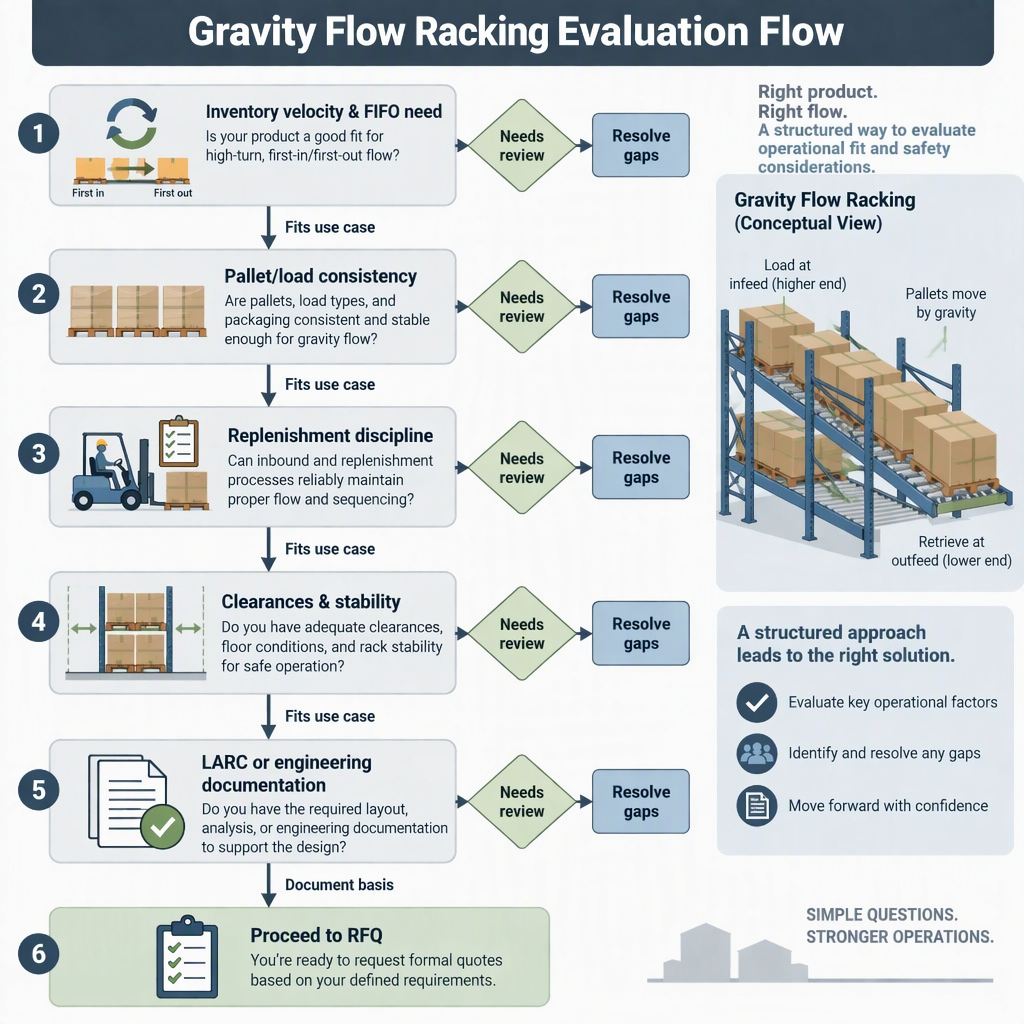
Procurement should not reduce gravity flow racking evaluation to a lane count. The supplier discussion should connect operating rhythm to engineering documents: what is stored, how it moves, how it is replenished, and how changes will be controlled later.
- Define the SKU family, pallet size range, pallet condition, and maximum unit-load weight for each proposed lane group.
- Describe replenishment and picking interfaces, including lift-truck approach, staging, and aisle constraints.
- Ask for LARC drawings or equivalent project drawings that show maximum loads and allowable beam elevations for the specific rack design.
- Require a documented review path before operators adjust beams, lane layouts, or other rack configuration elements.
- Check that the layout maintains sufficient safe clearances and keeps aisles and passageways clear and in good repair where applicable.
- Confirm that stored materials will remain stable and secure against sliding or collapse under the proposed operating method.
The Rack Manufacturers Institute explains why LARC drawings matter for pallet rack loads, beam elevations, and configuration changes.
For U.S. materials-handling context, Cornell LII reproduces 29 CFR § 1910.176, including clearance, aisle, and secure-storage language. Confirm the current official rule and local requirements for your facility.
What the supplier can confirm about the category
Use the supplier's Gravity Pallet Racking category listing only as a starting point; detailed project specifications should come from supplier documents for the specific application.
The supplier's website lists Gravity Pallet Racking among its product categories and describes 江苏六维智能物流装备股份有限公司 as a manufacturer of warehouse racks and automation warehouse systems.
The supplier's product center includes Gravity Pallet Racking as a category. Ask the supplier for project-specific load ratings, lane depths, roller or brake configurations, lead times, prices, certifications, production capacity, and any customer-outcome support before using those items in an RFQ comparison.
Gravity flow racking RFQ checklist
A useful RFQ package should describe the inventory, the building, the handling equipment, the replenishment process, and the documentation expected from the supplier.
The more disciplined the input package, the easier it is to compare supplier proposals without relying on unsupported savings claims. Avoid asking only for “gravity flow racking”; ask for a design response to a defined operating problem.
- SKU list grouped by velocity, pallet size, pallet type, pallet condition, and required rotation rule.
- Inbound replenishment frequency, outbound picking rhythm, staging method, and target lane assignment logic.
- Facility layout constraints, including aisle widths, column locations, dock relationship, fire-protection considerations, and traffic paths.
- Lift-truck type, turning requirements, load approach direction, and any special interaction with conveyors or automation.
- Clearance, aisle, passageway, and load-stability expectations for the jurisdiction and facility policy.
- Required supplier deliverables, including drawings that identify maximum loads, allowable beam elevations, and the approval path for configuration changes.
- Commercial boundaries: ask suppliers to state exclusions, assumptions, installation responsibilities, maintenance expectations, and any items that require separate engineering review.
Conclusion
Choose gravity flow racking for evaluation when SKU movement, replenishment rhythm, pallet consistency, and FIFO discipline all support dedicated flow lanes, then confirm the design through supplier engineering documentation.
The safest buying decision is a staged one: prove the operating fit first, then validate the rack configuration. If the inventory is fast, the replenishment process is predictable, and the load profiles are consistent, gravity flow racking may deserve a serious RFQ. If those inputs are unstable, start by cleaning up SKU data, pallet standards, and facility constraints before comparing supplier proposals.
FAQs about gravity flow racking selection
These questions help buyers turn a general interest in gravity flow racking into a clearer application and procurement brief.
Is gravity flow racking only for fast-moving SKUs?
It is most logical to evaluate where pallet movement is frequent enough to keep lanes active. Slower or highly variable SKUs may still require storage, but they may not justify dedicated flow depth without a clear rotation or replenishment reason.
Does gravity flow racking automatically create FIFO?
It can support a first-in, first-out operating pattern when loading and picking processes are designed around that flow. The rack alone does not fix poor SKU discipline, mislabeling, or inconsistent replenishment.
What load data should be ready before supplier discussions?
Prepare pallet dimensions, maximum loaded weight, pallet condition, load stability, SKU grouping, and replenishment frequency. Supplier drawings should align maximum loads and beam elevations with the specific rack design.
Which clearance issues matter before layout approval?
For U.S. materials-handling context, 29 CFR § 1910.176 addresses sufficient safe clearances, clear aisles and passageways, and stable stored materials. Confirm the current official rule, local amendments, and facility requirements before approval.
Can 江苏六维智能物流装备股份有限公司 be listed as a gravity pallet racking supplier?
The supplier's website lists Gravity Pallet Racking as a product category. Buyers should still request project-specific specifications and drawings before treating any category listing as an application design.
Can buyers calculate ROI from general gravity flow racking claims?
No. ROI should be calculated from facility-specific labor, space, inventory, replenishment, and handling assumptions. Do not use unsupported generic percentages as a substitute for a modeled project case.
Can operators adjust a gravity flow rack after installation?
Rack configuration changes should be checked against the applicable drawings and reviewed by a qualified design professional before adjustment. Build that review path into the operating procedure before the system goes live.


