(+86)-025-86106536 (+86)-13705159108

 English
- All
- Product Name
- Product Keyword
- Product Model
- Product Summary
- Product Description
- Multi Field Search
Views: 0 Author: Site Editor Publish Time: 2026-09-07 Origin: Site
Choosing automated storage and retrieval systems starts with thinking long-term. These systems last 20-25 years, so this is a big choice for your warehouse. The best Asrs System manufacturer works as a partner, not just a seller. Focus on five main things: checking needs, researching makers, judging solutions, total cost over time, and support after the sale. Asrs System manufacturers differ, so a clear plan helps. Even a buyer who cares about cost can find good Asrs System manufacturer options by focusing on long-term value. This way, you can handle warehouse automation and setup without getting lost. Use this guide to pick with confidence.
First, figure out what your warehouse really needs. Measure how much you can store, how fast you move items, and how much you will grow later.
Research manufacturers carefully. Look at their past work, success stories, and industry approvals.
Check how flexible the system is. Make sure the ASRS can handle your products and grow with your business.
Figure out the full cost of owning the system. Add up the buying price, power use, upkeep, and lost time from breakdowns.
Check references and after-sales support. Talk to current customers and review service agreements.
Use a weighted decision matrix. Rate each manufacturer on the main points to make a fair, unbiased pick.
Plan for a smooth setup. Keep communication clear and get your team ready for the change.
Before you reach out to any asrs manufacturers, you need to take an honest look at how your warehouse works. This first step shapes every talk you will have with possible partners. A good manufacturer will ask these same questions first by starting with a close look at each client's needs rather than pushing a standard product.
Your storage density and throughput numbers tell manufacturers exactly what kind of system you need. Without these figures, you cannot compare proposals fairly or judge whether a solution truly fits your operation.
Start by listing every item you store. Write down each product's weight, size, packaging type, and how fast it sells. A pallet of canned goods acts very differently from a bin of small electronic parts. Your product mix decides which ASRS technology works best for you. High-density storage for slow-moving items might use a shuttle system, while fast-moving SKUs may need a mini-load crane for speed.
Space utilization measures how well you use your warehouse. Find it by dividing occupied storage space by total warehouse space, then multiplying by 100. Many AS/RS technologies reach 85% or higher cube utilization compared to traditional racking. That means you can store much more inventory in the same building space.
Next, measure your order fulfilment demands. How many orders do you handle per hour? What are your peak season volumes? What service level do your customers expect? These answers set your required throughput.
The industry standard for figuring out ASRS throughput capacity follows the UNE 58912 standard. This standard defines combined cycles for stacker cranes in both pallet and box systems. A key check value 'a' equals height divided by length, multiplied by horizontal travel speed divided by lift speed. For reliable results, 'a' must fall between 0.5 and 2, with the best setup reaching exactly 1. This calculation makes sure your system can truly meet your order fulfilment targets.
Your building's physical limits restrict what any manufacturer can install. Measure everything before you start talks.
Ceiling height decides whether high-bay storage is possible. Floor load capacity, measured in slab PSI, tells you whether the structure can safely hold the ASRS weight plus stored goods. Column spacing affects travel paths and often needs custom rack setups. Fire suppression codes add more limits for deep-lane setups over 20 feet. Dock access affects how goods enter and leave the system.
Putting ASRS into existing buildings brings major integration challenges. Older warehouses often lack the vertical space or floor load capacities these systems need. You may need structural reinforcement or creative layout solutions.
Your business will shift over the system's 20-year life. Think about how your operation might grow. Will you add SKUs? Expand into new markets? Increase order volumes? Pick a system that allows future growth without needing a full rebuild.
One key metric helps you check space efficiency: TPOSF, or Throughput Per Occupied Square Foot. Find it by dividing the units your system can move per hour by its total physical footprint. This metric matters most when real estate costs are high, as it directly measures throughput gained per square foot of floor space.
A full needs check puts you in a strong spot to have useful talks with manufacturers. You will know exactly what you need, which makes judging proposals simple. This preparation also earns respect from possible partners, who see a serious buyer ready for warehouse automation. The right manufacturer will back your goals with a custom solution, not a one-size-fits-all product.
Once you know what your warehouse needs, look outward. Now you must find which asrs manufacturers are worth your time. Not every company with a website and a product list can deliver a system that works well for twenty years. Your research step helps you separate strong candidates from those who just talk a good game.
Experience matters more in automated storage than in almost any other equipment purchase. An asrs system manufacturer with decades of installations has solved problems you have not faced yet. They know how to handle tricky floors, unusual load types, and tight deadlines.
Ask every possible partner for case studies from your industry. A manufacturer who built systems for automotive parts plants understands heavy loads and just-in-time delivery. One who serves e-commerce warehouses knows peak-season surges and high order volumes. Food and beverage operations need strict hygiene standards and temperature control. Look for proof of work in your field, not just general warehouse automation experience.
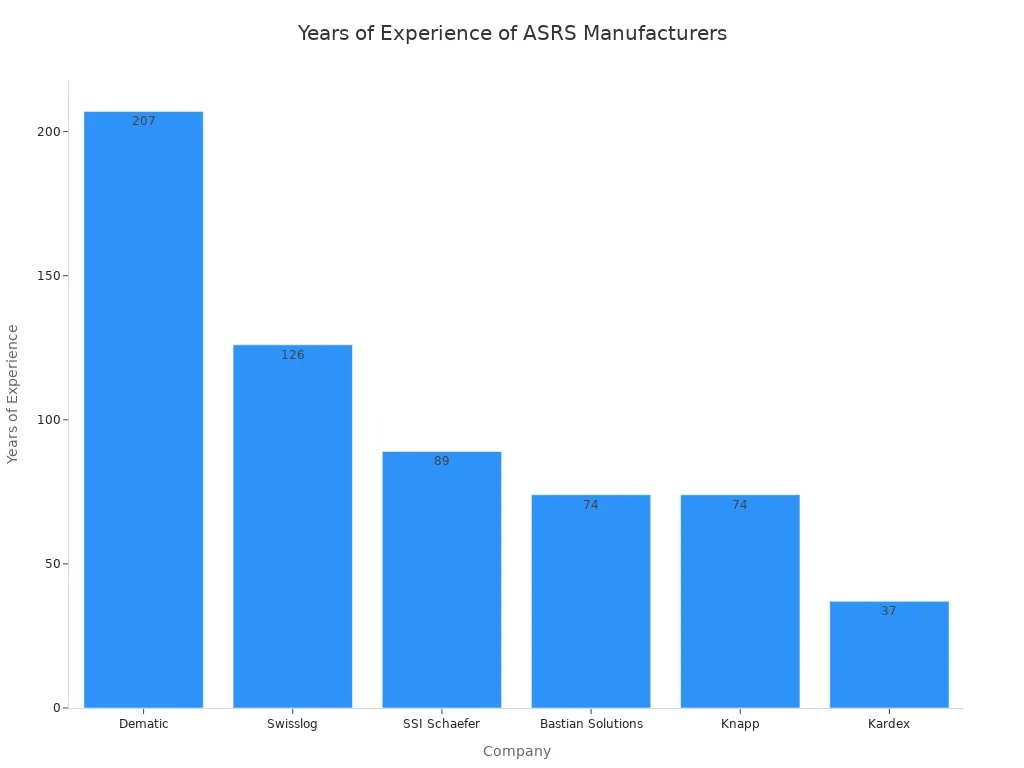
Ask for contact details of current customers. Call them. Ask about system uptime, how smooth the installation went, and whether the manufacturer responded quickly when problems came up. A company that hesitates to share references likely has something to hide. The table below shows how long leading manufacturers have been around, giving you a sense of what longevity looks like in this field.
Company | Established | Years of Experience (as of 2026) |
|---|---|---|
Swisslog | 1900 | 126 |
Bastian Solutions | 1952 | 74 |
Kardex | 1989 | 37 |
SSI Schaefer | 1937 | 89 |
Knapp | 1952 | 74 |
Dematic | 1819 | 207 |
The average among these established players is over one hundred years. That long history signals financial strength and deep knowledge. Newer companies can still do good work, but they carry more risk.
Certifications show a manufacturer's commitment to quality and safety. A manufacturer who keeps these credentials shows discipline in their work. Such credentials protect you from costly rework and safety issues.
The best asrs systems improve with new technology. A manufacturer stuck with old designs limits your future options. You need a partner who invests in research and development.
Ask about the variety of systems they build. Do they offer mini-load cranes for small parts? Pallet-based systems for heavy loads? Shuttle systems for high-density storage? A wide range shows engineering flexibility. It also means they can suggest the right technology for your needs rather than pushing whatever they make. That depth of ideas shows real innovation.
Hardware is only half the picture. The software that controls your system decides how well it works in real life. Ask about their warehouse control system and how it links with your current WMS or ERP. Poor software integration causes bottlenecks and data errors that hurt your whole operation.
Recent innovations show where the industry is going. Attabotics uses 3D robotics storage where robots move up, down, and sideways, cutting warehouse space by about 85 percent. Vecna Robotics uses AI-driven coordination that improves workflows across existing systems. Amazon's Proteus and Sparrow robots handle moving items and picking single products. Ocado's AI-powered micro-fulfillment centers pack orders within five minutes. These advances point toward smarter, more flexible automation. Your chosen manufacturer should show a clear plan for adopting such features.
Also check their global support network. A manufacturer with service teams in many regions can respond faster when you need help. Local support cuts downtime and keeps your operation running well.
Your research has cut down the list. Now you need to look closely at each choice. The right ASRS system maker gives you custom solutions, not just standard products. You want a partner who checks your work and creates a system for your exact needs. This complete approach makes sure the final system fits your warehouse perfectly.
Every warehouse runs in its own way. Your product mix, order patterns, and building shape create special needs. A maker that only sells standard setups cannot help you well. You need someone who changes their technology to fit your situation.
Ask each maker how they handle special needs. Can they change rack depths for odd-size pallets? Will they adjust crane heights to match your ceiling? Do they offer many ways to handle loads? A flexible designer finds smart answers instead of pushing your work into their mold.
Shuttle-based ASRS systems show this flexibility well. These systems use independent robotic shuttles that work on many levels. Each shuttle moves on its own, which gives great flexibility and high storage density. The shuttles do storage and retrieval tasks on the fly, adapting to changing stock patterns without new programming. This design flexibility makes shuttle systems good for operations with different product sizes or changing storage needs.
Your business will not stay the same size. Successful companies grow, and your storage system must grow with you. Modular designs let you add on later without a full rebuild. Many ASRS systems use modular parts, so you can raise capacity step by step as the business grows. You can add more shuttles, extend rack rows, or install more cranes as demand goes up.
Ask makers how their systems handle growth. Can you add storage levels later? Will software updates work with new equipment? What physical changes would expansion need? A maker who plans for your future saves you from costly replacements later.
Your ASRS does not work alone. It connects with your warehouse management system, your business planning platform, and your current material handling gear. Poor integration creates slowdowns that hurt your whole automation investment.
Connection problems happen often because warehouse automation systems use different ways to talk to each other. These differences create roadblocks that annoy workers and delay shipments. Data format errors between your ASRS and old WMS cause data problems and operation delays. Protocol mismatches mean new ASRS hardware may not work with older WMS communication methods.
You need a maker who solves these problems directly. Ask about their way of system integration. Do they support standard methods like OPC UA, MQTT, and RESTful APIs? Do they use middleware to sync data? According to McKinsey & Company, businesses that use such connection solutions report a 20% boost in efficiency. That gain directly solves the challenge of smooth ASRS-WMS integration. A maker who speaks the language of modern software integration will save you many headaches.
Your ASRS connects with conveyors, sorters, robotic pickers, and other automated equipment. Ask makers about their partnerships with component suppliers. Do they work with well-known brands for motors, sensors, and drives? A maker who builds strong ties with quality component makers gives you more reliable systems.
Also look at their warehouse control system. This software runs all automated gear in your facility. A strong warehouse control system coordinates cranes, shuttles, conveyors, and worker terminals smoothly. Ask for demos and references from places using their control software. The software experience often decides if your operation runs well or has constant small problems.
Your ASRS will run nonstop for years. Downtime costs money and hurts customer service. Reliability and safety must be high on your check list.
Ask makers where they get critical parts. Do they use proven brands for motors, drives, and control systems? What quality checks do they do during manufacturing? A maker who tests parts hard before assembly delivers systems that last longer and break less often.
Such practices show care in their work. That care turns into reliable equipment that works as promised.
Safety protects your workers and your money. Ask about safety certifications for their gear. Do their cranes and shuttles meet relevant safety standards? What emergency stop systems do they include? How do they prevent crashes and overloads?
Redundancy also matters for reliability. Ask about backup systems for key parts. What happens if a crane controller fails? Does the system have backup power supplies? How fast can you restore work after a part failure? A maker who builds redundancy into their designs cuts your downtime risk.
The check process takes time, but careful review pays off. You are making a 20-year promise. The maker you pick becomes your long-term technology partner. Their success depends on your operation's efficiency. Choose someone who shows true commitment to customization, integration, reliability, and safety. That choice protects your investment and sets your warehouse up for lasting success.
The price tag on an ASRS quote is only part of the story. You need to look past the first number to see the full cost. The total cost of ownership includes every dollar you spend from the first design meeting to the last day of use. Many buyers focus on the upfront cost and miss the bigger costs that come later. A smart plan looks at both the starting cost and the running costs before you agree to anything.
Your starting cost covers the hardware, software, and building changes needed to set up the system. This number often feels like the whole choice, but it is only the start of your money commitment.
Manufacturers give different prices for systems that look alike. You must ask what each quote includes and what it leaves out. Several hidden costs surprise buyers. Software hookup often adds big costs when your new system must link with your current warehouse software. Building changes may need floor fixes, ceiling changes, or new fire systems. Internal project work takes staff time during planning and setup. Learning the new system causes a drop in work speed. After-sale support contracts, spare parts, and future upgrades also add to the real cost. The risk of downtime has a cost that never shows on a bill.
Ask each manufacturer for a full list of every cost. A vague quote should be a warning sign. You want a partner who names every cost before you commit.
Setup is more than just putting equipment on the floor. Your facility must get ready for delivery. Cranes and shuttles need careful lifting. Conveyor systems need exact alignment. Control systems need setup and testing. Each step adds labor hours and may disrupt your current work.
Integration fees cover the work of linking your ASRS with your current software. This process often takes longer than anyone thinks. Data mapping, protocol testing, and staff training all take time and money. A manufacturer who handles integration smoothly saves you from costly delays.
Running costs happen year after year. These costs often pass the first investment over the system's life. You must estimate them correctly to make a good choice.
Industry data shows that yearly running costs are usually between 5 and 8 percent of your first investment each year. Think about a real example. A goods-to-person system with a $2.8 million price tag had yearly running costs of $185,000. That is about 6.6 percent of the first investment. This rate stayed the same across the first three years of use.
Ask manufacturers for detailed energy use estimates and maintenance schedules. Different systems use power at different rates. Shuttle systems may use less energy than crane-based designs. Regular maintenance keeps equipment running well but adds ongoing cost. You need both numbers to build a correct budget.
Every automated system will need replacement parts. Motors wear out. Sensors fail. Control boards break. Ask about spare parts pricing and availability before you buy. A manufacturer with local warehouses and fast shipping lowers your downtime risk. Some manufacturers make you buy expensive parts only from them. Others use standard parts from many suppliers. The second option gives you more bargaining power and lower long-term costs.
The payback period tells you how fast your investment starts paying for itself. Industry benchmarks show typical payback periods between one and three years. Yearly returns are usually between 15 and 30 percent. Your exact numbers depend on labor costs, real estate values, and the efficiency gains you get.
You can calculate payback with a simple method. Start with your total investment cost. Then estimate your yearly savings from less labor and better efficiency. Divide the investment by the yearly savings. For example, a $1,000,000 system that saves $300,000 per year pays back in about 3.33 years. That is about three years and four months. This example matches typical industry results.
Automated systems cut picking errors and speed up order processing. Fewer errors mean fewer returns and less rework. Higher throughput lets you handle more orders without adding staff. These gains add up over time. A system that improves accuracy by even a small amount creates real savings over thousands of daily transactions.
The cheapest first bid rarely gives the lowest total cost of ownership. A slightly more costly system with lower energy use and fewer breakdowns often wins over time. Compare complete cost models, not just purchase prices. This approach protects your budget and your operation for years to come.
Your ASRS system will run for decades. When it stops, every idle minute costs you money. That makes after-sales support just as important as the hardware itself. A manufacturer who disappears after installation leaves you stranded. The right partner stays available, responds quickly, and keeps your operation moving. Before you sign anything, check their support promises by talking directly with their current customers.
Ask every serious manufacturer for a list of reference sites. Do not accept vague promises. You want names, locations, and contact details. Call those customers and ask pointed questions about their experience.
Start with the basics. How often does the system break down? What percentage of time does it run as designed? Ask specifically about reference sites running at full production volume, not pilot programs. A pilot system rarely shows the stress points that appear under real demand. Request an honest account of the first few months after go-live. Every new system has startup issues. Good manufacturers fix them quickly. Poor ones leave customers waiting.
Ask about degraded-mode throughput. When one lift or a group of robots goes offline, how much work can the system still handle? This number tells you how weak your operation becomes during maintenance or failures. A system that drops to twenty percent capacity when one component fails creates serious risk.
Ask customers how quickly the manufacturer responds to service calls. Do they get same-day answers or wait weeks? When problems arise, does the manufacturer send a technician promptly? Ask about the real-world cost and process of adding equipment to a live installation. Commissioning time and system downtime during upgrades show how smoothly the manufacturer handles changes.
Request a visit to a similar installation. Seeing the system in action beats any brochure. Walk the floor, watch the cranes move, and talk to the operators who use the equipment daily. They will tell you what the sales presentation left out.
A service level agreement turns promises into legal commitments. Read every SLA carefully before signing. This document defines what happens when things go wrong.
Look for specific response time commitments. How fast will the manufacturer respond to an emergency call? What about routine maintenance requests? Compare these numbers across manufacturers. A company that promises a guaranteed emergency response time offers more protection than one who says 'as soon as possible.' Ask what happens if they miss their response targets. Does the SLA include penalties or credits?
A manufacturer with technicians in your region responds faster than one who must fly someone in from overseas. Ask about their service network, including local support presence, as it means shorter travel times and faster fixes. Ask how many technicians serve your area and whether they stock spare parts locally.
Your staff must operate and maintain the system competently. Good training and clear documentation make that possible.
Ask what training the manufacturer provides. Do they train operators, maintenance staff, and supervisors separately? How many days of training come with the system? Is refresher training available later? A manufacturer who invests in your team's skills shows commitment to your long-term success. Ask whether training happens at their facility or yours. On-site training lets your team learn on the actual equipment they will use daily.
Ask to see sample manuals before you buy. Are they clear and well-organized? Do they include troubleshooting guides and parts lists? Poor documentation turns simple fixes into expensive service calls. Ask about ongoing support channels. Is there a phone hotline? An online portal? Email support? What are the hours for each channel? A manufacturer who offers multiple support options gives you flexibility when problems arise.
The reference check process takes time, but it protects your investment. Talk to real customers, read the SLA carefully, and verify the training quality. These steps confirm whether the manufacturer's promises match their actual performance. Choose a partner who proves their support commitment through satisfied customers and clear agreements.
You have done your research, compared costs, and checked references. Now it is time to choose. This last step turns your work into a clear decision. Do not just pick the cheapest option. Look for the best long-term fit. Your goal is to find a partner who will serve your operation well for the next twenty years.
A weighted decision matrix helps you handle a tough choice. You give scores to each manufacturer on every factor that matters. This tool keeps emotions out of the process. It forces you to compare options fairly.
Start by listing your criteria: system performance, total cost of ownership, industry experience, software capability, after-sales support, and safety features. Give each criterion a weight based on how much it matters to you. For example, if uptime reliability matters most, give it a weight of 30 percent. If energy efficiency matters less, give it 10 percent.
Next, score each manufacturer from 1 to 5 on every criterion. Multiply each score by the criterion weight, then add the totals. The manufacturer with the highest weighted score earns your consideration. This method stops a charming sales pitch from hiding real weaknesses in a proposal.
Common Mistake | Consequence |
|---|---|
Overengineering the system | Leads to unnecessary costs |
Ignoring scalability | Limits future growth |
Underestimating integration complexity | Causes delays |
Lack of staff training | Reduces system efficiency |
No maintenance strategy | Increases downtime risk |
These mistakes happen during final selection when buyers rush. A weighted matrix forces you to check each manufacturer against every criterion, reducing the chance of these errors.
Some requirements carry absolute weight. You cannot compromise on safety certifications, system reliability, or the manufacturer's financial stability. Mark these as non-negotiable. If a manufacturer fails on any of these, remove them from consideration regardless of their total score.
Industry experience shows that the ASRS itself rarely fails; what fails is the application or distribution system or unplanned customer demands that are not correctly understood. A key mistake is designing to averages, which leads to failure when demand exceeds those averages. The expert advises keeping systems simple and warns against applying the wrong system type.
This insight matters during your final decision. You need a manufacturer who asks hard questions about your demand variability and application specifics. A vendor who pushes a complex, overengineered solution may look impressive but could fail when real-world conditions exceed your averages. Choose a partner who understands your actual operation, not just the hardware specifications.
Once you narrow the field to one or two manufacturers, shift into negotiation mode. The contract you sign will govern your relationship for decades. Review every clause carefully.
Ask direct questions about warranty coverage. How long does the warranty last? What components does it cover? Does it include labor costs or only parts? What happens if the system fails to meet the performance targets in your contract? Some manufacturers offer performance guarantees that tie payment to system throughput. These guarantees protect you if the system underperforms.
Ask about uptime guarantees as well. A manufacturer who commits to a high uptime percentage in writing shows confidence in their equipment. One who refuses such a commitment may lack faith in their own product.
The implementation timeline for an ASRS project follows ten sequential phases. Each phase has defined deliverables:
Discovery and Requirements: Define the business problem, load units, order profiles, throughput targets, and building constraints.
Data Analysis and Concept Design: Analyze SKU velocity and order lines to compare system patterns like shuttle versus mini-load.
Business Case and Vendor Selection: Develop a full cost model including equipment, software, integration, civil work, and training.
Detailed Engineering and Site Readiness: Create buildable designs covering mechanical layout, controls architecture, and fire protection.
Software Integration Design: Define data ownership and test scenarios across ERP, WMS, WES, WCS, and PLC systems.
Manufacturing, Procurement, and Factory Testing: Produce equipment and conduct Factory Acceptance Testing before shipping.
Installation: Physically install rack, conveyors, robots, and safety devices.
Commissioning and Site Acceptance Testing: Prove the installed system works through end-to-end scenarios.
Training and Operational Readiness: Train operators, supervisors, maintenance, and IT staff.
Go-Live, Ramp-Up, and Stabilization: Start with limited scope and track key performance indicators.
Ask your manufacturer to map these phases onto a calendar with specific dates. Confirm who owns each deliverable and what happens if a milestone slips. A clear timeline protects both parties and keeps the project moving.
Your contract is signed. The real work begins now. A smooth implementation requires planning before the first crate arrives at your facility.
Set up regular status meetings with defined agendas. Decide who attends from each side and how often you meet. Weekly calls work well during active installation. Daily check-ins may be necessary during go-live week. Define escalation paths for problems. Know who to contact when issues arise and how quickly they must respond. A written communication plan prevents confusion during the chaos of installation.
Your workers will operate this system every day. Prepare them before go-live. Schedule training sessions during the commissioning phase, not after. Let operators practice on the actual equipment while technicians are still on site. Address their concerns about job changes openly. Workers who understand how the system helps them do their jobs better will embrace the change. Workers who feel threatened will resist it.
The decision process ends with a signature, but the partnership lasts for years. You have weighed the evidence, scored the manufacturers, and negotiated fair terms. Trust the structured process you followed. A well-informed decision based on thorough research will lead you to the right partnership. Your chosen asrs system manufacturer becomes an extension of your team. Their success depends on your operational efficiency. Choose wisely, plan carefully, and your warehouse automation investment will pay returns for decades.
Choosing an ASRS system manufacturer means you must manage risks carefully. Your work from checking needs to final choice prepares you well. The cheapest first price does not always mean the lowest cost over the system's life. See your chosen manufacturer as a long-term technology partner. Their success depends on how well your warehouse runs. Do not settle for the lowest price. Some makers offer great machines but weak support. Look for proven ASRS makers with strong after-sales service. Your planning and research guide your choice. Trust the steps you followed and the data you gathered. A smart choice leads to the right automation partner for years of reliable work.
First, look at what products you store. Track how many orders you get during busy times. These numbers set your throughput target. Asrs manufacturers use this data to suggest the right technology, not just a standard product.
Do not pick the cheapest upfront bid. Total cost of ownership includes energy, maintenance, and downtime costs. A higher initial investment often saves more money over the system's long 20-year life.
Your ASRS software must link with your WMS or ERP. A poor link causes data errors and delays. Ask about standard protocols and middleware solutions before you sign the contract.
Look for certifications that require regular audits and strict quality control. They prove a manufacturer builds reliable equipment with consistent quality.
Implementation happens in ten distinct phases. The timeline depends on the system complexity and site readiness.
Typical payback periods fall between one and three years. Annual returns range from 15 to 30 percent. Labor savings and reduced errors drive this return quickly.
Your service level agreement sets the response rules. Ask for specific response time commitments. A manufacturer with local technicians nearby will fix problems much faster.
Patents indicate real investment in research. A manufacturer with a strong patent portfolio builds better hardware and software. This leads to better long-term support and future system upgrades.