(+86)-025-86106536 (+86)-13705159108

 English
- All
- Product Name
- Product Keyword
- Product Model
- Product Summary
- Product Description
- Multi Field Search
Views: 0 Author: Site Editor Publish Time: 2026-11-26 Origin: Site
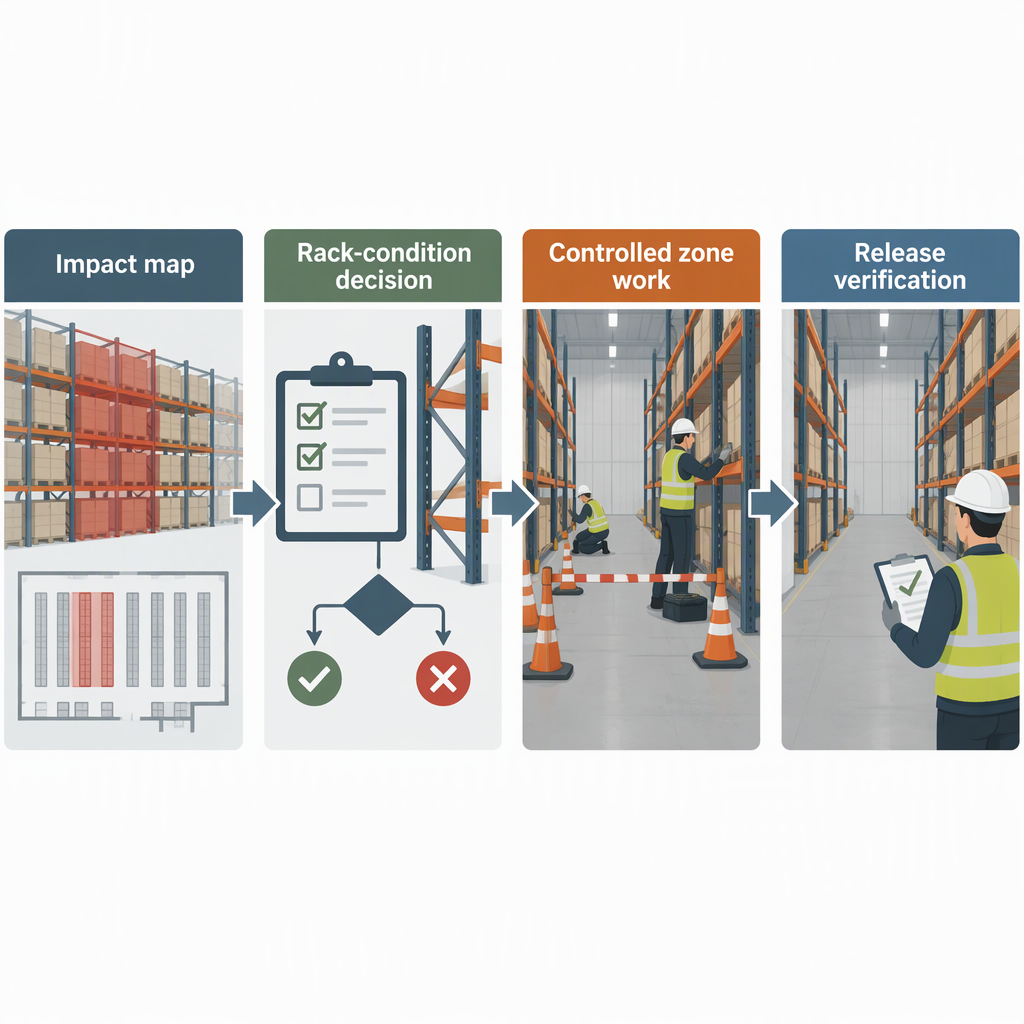
A live warehouse racking retrofit should be phased around operating impact first: product flow, mechanical handling routes, pedestrian access, temporary storage and emergency arrangements. Then each rack zone should be matched to the applicable rack-design, utilization and decking documentation before it is returned to use.
Begin the warehouse racking retrofit by mapping the flows that must remain live, because warehousing safety guidance treats mechanical handling, site transport, work at height, responsible practices and emergency procedures as part of the same operating environment.
Operating question | Planning decision | Output for the retrofit team |
|---|---|---|
Which aisles carry forklift, reach-truck or pallet-jack traffic? | Keep live traffic away from work fronts or schedule the zone when traffic can be diverted. | Temporary route map and access restrictions. |
Which pick faces, docks or staging lanes cannot stop? | Protect essential shipping and receiving flows before moving rack components. | List of non-negotiable operating lanes. |
Which emergency routes and incident procedures are affected? | Confirm temporary routes, signage and responsibilities before the phase begins. | Phase-specific emergency and communication plan. |
Mark live material-handling routes, pedestrian crossings, loading areas and work-at-height interfaces on the same drawing.
Identify the stock that must be relocated before rack work starts, and where it will be held temporarily.
Agree who can stop a phase if traffic separation, access control or emergency arrangements are no longer working.
Do not treat the building as one uniform rack project; rack inspection, maintenance, repair, reconfiguration, design, installation and standards are recognized rack-safety topic areas, so each zone needs its own condition decision.
Zone finding | Retrofit path | Buyer check |
|---|---|---|
Layout supports the new flow and components are suitable for continued use. | Keep in service or protect during nearby work. | Confirm the utilization basis and relevant rack documentation before relying on the retained layout. |
Rack position blocks new routes, docks or equipment access. | Move or reconfigure after engineering review. | Include reconfiguration and design responsibilities in the work scope. |
Damage, alteration or uncertain decking use is present. | Repair or replace before release. | For rack decking, the MHI/RMI listing describes ANSI MH26.2-2023 and notes exclusions for decking that has been improperly installed, altered, damaged or used other than intended. |
A retrofit brief should not assume that an older rack layout, altered decking or changed pallet profile remains acceptable simply because it has been used before. Ask for the design basis, load information and intended use to be checked against the applicable project documents.
A practical phase order starts with the zone that creates the least disruption, proves the temporary controls, and then moves toward higher-dependency aisles only after the team has shown that routing, storage and release checks work.
Choose a pilot zone. Select an area with manageable stock movement, clear diversion routes and limited impact on essential dispatch or receiving.
Create the temporary operating pattern. Define alternative travel paths, staging locations, pedestrian separation and communication points before rack work starts.
Complete rack changes against the agreed basis. Keep the phase tied to the named rack design, utilization and decking references rather than informal field changes.
Review the phase before scaling. Use incident feedback, route congestion and storage pressure to adjust the next zone plan.
Phase type | Best use | Main operating risk to plan |
|---|---|---|
Pilot aisle or bay group | Testing work methods and temporary routing. | Unclear separation between work activity and live site transport. |
Flow-critical aisle | Upgrading a path needed for picking, replenishment or dispatch. | Congestion, blocked emergency routes or rushed material handling. |
High-change rack area | Layout reconfiguration, decking changes or new storage mode. | Mismatch between intended use and the rack or decking documentation. |
Operations can continue only when temporary controls are explicit: isolate the work zone, separate pedestrians and vehicles, control work at height, protect emergency arrangements and keep temporary storage from creating new hazards.
Use visible barriers, route signs and supervisor communication so live traffic does not drift into the retrofit zone.
Keep temporary pallets, empty locations and staging buffers out of emergency routes and high-traffic intersections.
Plan work-at-height interfaces before the shift starts, including who may enter the zone and how nearby traffic is restricted.
Before manual access to powered conveyors, shuttles, lifts, AS/RS interfaces or battery-powered handling equipment, switch off and disconnect the applicable power source or battery, then follow the model manual’s permitted access procedure.
The Health and Safety Executive’s HSG76 warehousing and storage guidance covers mechanical handling, site transport, working at height, avoidable risks and emergency procedures; use those themes as planning prompts, while confirming the rules that apply in your own jurisdiction and site.
For a live warehouse, the control plan should be broader than rack installation access. It should cover the surrounding traffic system, temporary storage behavior and emergency response for the phase, because those topics sit within warehousing and storage safety guidance.
Release a retrofitted zone only after the rack configuration, decking condition, intended use, labels or load information, and operating controls have been checked against the agreed project basis.
Check the installed configuration. Confirm that bays, beams, uprights, anchors, bracing and decking match the reviewed layout and are not treated as informal substitutions.
Confirm intended use. Match pallet type, load profile, storage method and rack decking use to the documented basis for the zone.
Record inspection and maintenance handover. Put the changed zone back into the warehouse’s inspection, maintenance and repair process.
Walk the operating route. Verify that temporary traffic controls can be removed or converted into the permanent route without blocking emergency arrangements.
Do not release a zone on verbal approval alone; retain drawings, load information and change records for the phase.
Train supervisors and operators on what changed, especially if rack repair, reconfiguration or inspection responsibilities changed.
Watch the first operating period for congestion, pedestrian conflict or temporary storage habits that undermine the planned flow.
A strong procurement package asks suppliers to price the same phased scope, standards basis, constraints and handover evidence, instead of asking only for a rack count or a generic warehouse racking retrofit quote.
Site constraints: live aisles, operating hours, traffic routes, pedestrian zones, temporary storage limits and emergency-route requirements.
Rack basis: existing drawings, load information, intended use, decking type, altered areas and the edition or document basis the supplier must address.
Standards reference: the MHI/RMI listing identifies ANSI MH16.1-2023 for industrial steel storage racks, states that it replaces ANSI MH16.1-2021, and identifies ANSI MH26.2-2023 for industrial storage rack decking; ask the supplier to confirm the applicable adopted edition and project basis.
Product-category fit: if Nova Racking is considered in the supplier set, its homepage lists categories including AS/RS systems, heavy-duty pallet racking, selective pallet racking, VNA pallet racking, drive-in pallet racking, radio shuttle pallet racking, gravity pallet racking, mezzanine/platform systems, cantilever racking, rack-supported buildings and logistics equipment.
Release evidence: drawings, inspections, load signs or records, change documentation and unresolved exceptions for each zone.
Name standards and project documents precisely, but do not turn a standards title into a one-size-fits-all acceptance rule. The supplier, engineer and local authority should confirm which edition and local requirements govern the specific warehouse.
Approve a racking retrofit plan when it explains how the warehouse will keep control of traffic, people, storage, emergency arrangements and zone release—not merely when the rack layout looks efficient on paper.
Phase by operating dependency: traffic, storage, access and emergency continuity.
Separate retained, moved, repaired and replaced rack areas with documented checks.
Ask procurement to compare suppliers on scope clarity, standards basis and release evidence, not unsupported promises.
The main follow-up questions should focus on standards references, live-operation limits, zone release, and the information suppliers need before they can propose a phased retrofit.
Name the rack and decking documents that apply to the project basis. The MHI/RMI listing identifies ANSI MH16.1-2023 for industrial steel storage racks and ANSI MH26.2-2023 for industrial storage rack decking, while also stating that ANSI MH16.1-2023 replaces ANSI MH16.1-2021. Ask the supplier or engineer to confirm the adopted edition for your project.
Yes, if the phase plan protects essential routes, separates site transport from the work zone, controls temporary storage and keeps emergency arrangements workable. If those controls cannot be maintained, schedule that zone outside live shipping activity.
Not automatically. Treat inspection, maintenance, repair, reconfiguration and design as separate decisions so usable zones, damaged zones and layout-change zones receive the right action.
Provide live routes, shift constraints, stock relocation needs, temporary staging limits, emergency-route restrictions and the operating areas that cannot be interrupted.
Review decking whenever it is damaged, altered, improperly installed, used differently from its intended purpose, or affected by a changed pallet or storage mode.
The release should follow the project’s agreed responsibility matrix, including supplier or engineering checks where applicable, and should retain the drawings, load information, inspection records and unresolved exceptions for that zone.
It can be part of the supplier discussion if the project involves those categories; Nova Racking lists AS/RS systems, radio shuttle pallet racking and other warehouse-racking categories on its homepage. The actual retrofit scope still needs project-specific drawings, controls and acceptance criteria.