
 English


A useful warehouse racking RFQ should give suppliers more than warehouse dimensions: include load data, pallet details, building constraints, material-handling equipment, traffic and aisle assumptions, operating workflow, and any existing-rack condition records so the supplier can prepare a layout discussion around the way the site will actually be used.

- Treat pallet weight, load distribution, rack use, and loading practices as core RFQ inputs because storage-rack risk is closely tied to overloading, unsafe loading, installation, maintenance, and use conditions.
- Include site-transport, mechanical-handling, work-at-height, and emergency-access context where it affects the proposed racking layout.
- If the project touches existing racks, collect inspection and condition information before asking suppliers to price reuse, relocation, or extension work.
Why RFQ data matters before racking layout work starts
Suppliers cannot responsibly evaluate a racking layout from floor area alone because rack suitability depends on how loads, pallets, equipment, aisles, maintenance, and daily use interact.
WorkSafeBC identifies improper installation, inspection, use, maintenance, overloading, poor maintenance, and unsafe loading practices as storage-rack risk factors, so an RFQ should describe how the racks will be loaded and used rather than only asking for a price per bay.
The Health and Safety Executive warehousing and storage guidance also places warehouse planning in a broader operating context that includes mechanical handling, site transport, working at height, and emergency procedures.
For procurement teams, accurate layout work starts with operating facts. The RFQ should show the site, goods movement, and constraints that affect access and handling.
Warehouse racking RFQ checklist: the data to send suppliers
Send a structured warehouse racking RFQ package that covers loads, pallets, building dimensions, equipment, aisle needs, workflow, site-safety constraints, and project scope before asking for a layout or quotation.
- Product and pallet profile: pallet type, pallet dimensions, unit-load height, maximum load weight, load stability, overhang, and whether loads are uniform or mixed.
- Storage requirement: number of pallet positions, SKU mix, turnover pattern, reserve storage needs, picking requirements, and any segregation rules that affect rack zones.
- Building information: floor plan, clear height, column grid, dock positions, doors, fire exits, emergency routes, obstructions, slab condition information available to the buyer, and areas that must remain accessible.
- Handling equipment: forklift or truck type, turning radius information available from the equipment supplier, lift height, travel path, charging or fueling zones, and pedestrian separation needs.
- Operating conditions: shift pattern, loading method, expected traffic intensity, maintenance access needs, and known rack-use practices that could influence layout review.
- Existing-rack documents: rack drawings, load notices, inspection reports, photos of damage, repair records, and relocation history when the RFQ involves existing equipment.
Load and pallet data suppliers need first
Start with the heaviest and most demanding loads, not the average pallet, because unsafe loading and overloading are recognized storage-rack risk factors.
The WorkSafeBC storage-racks guidance highlights overloading, poor maintenance, and unsafe loading practices among the issues associated with storage-rack safety, so RFQ data should make load assumptions explicit.
- State the maximum pallet weight and identify whether that weight is a rare maximum, a normal operating load, or a planned future load.
- Describe the load footprint, including pallet size, product overhang, load height, and whether the load is stable, wrapped, bagged, boxed, caged, or irregular.
- Tell suppliers whether pallets will be handled from the long side or short side, and whether any loads require special positioning or additional support.
- Separate current needs from future assumptions, such as heavier inbound products, new pallet formats, or changes in picking activity.
- Do not ask suppliers to infer safe load ratings from product categories alone; provide the actual load data your operation can verify.
A clearer load schedule improves supplier questions: the discussion can focus on whether the stated pallet, load, and handling pattern fits the proposed layout approach.
Building, aisle, equipment and workflow data
Layout accuracy improves when the RFQ explains how people, forklifts, pallets, and emergency routes move through the warehouse.
- Map fixed constraints. Provide drawings or marked plans showing columns, walls, dock doors, ramps, office or production interfaces, exits, fire equipment, utilities, and areas that cannot be blocked.
- Define transport routes. Show inbound, putaway, replenishment, picking, staging, and outbound flows so suppliers can understand site-transport and mechanical-handling constraints.
- List equipment assumptions. Include the handling equipment type and operating envelope information available from the equipment provider, especially where aisle width, lift height, and turning movement affect the layout.
- Identify access needs. Mark maintenance areas, pedestrian routes, emergency paths, and zones where work at height may occur.
Do not reduce the RFQ to a storage-density request when transport, access, emergency, or work-at-height constraints apply. Those conditions can change supplier questions before final layout approval.
Existing rack condition and reconfiguration data
If the project reuses, extends, relocates, or works around existing racks, include condition records and inspection history before asking suppliers to quote the change.
- Provide the latest rack inspection records available to the site and identify who performed the inspection.
- Attach photos of damaged uprights, beams, connectors, anchors, bracing, protection devices, and areas with impact history.
- State how the existing racks are currently used, including load types, loading practice, maintenance concerns, and any known overloading or unsafe loading issues.
- Include original drawings, load notices, repair documentation, and previous reconfiguration records when available.
- Ask suppliers to state what additional inspection or engineering review they require before they rely on existing components.
For British Columbia context, WorkSafeBC provides a pallet rack inspection checklist connected to qualified-person inspection under section 4.43.1 of the British Columbia Occupational Health and Safety Regulation. For a global RFQ, use that as a reminder to collect condition records and confirm the locally adopted rules for your site.
Condition information is especially important because rack risk is not limited to the original installation; use, inspection, maintenance, loading practice, and later changes all affect the review questions a supplier should ask.
RFQ data priority table for procurement teams
When some information is not ready, separate mandatory data from conditional and follow-up data so suppliers know which assumptions cannot be guessed.
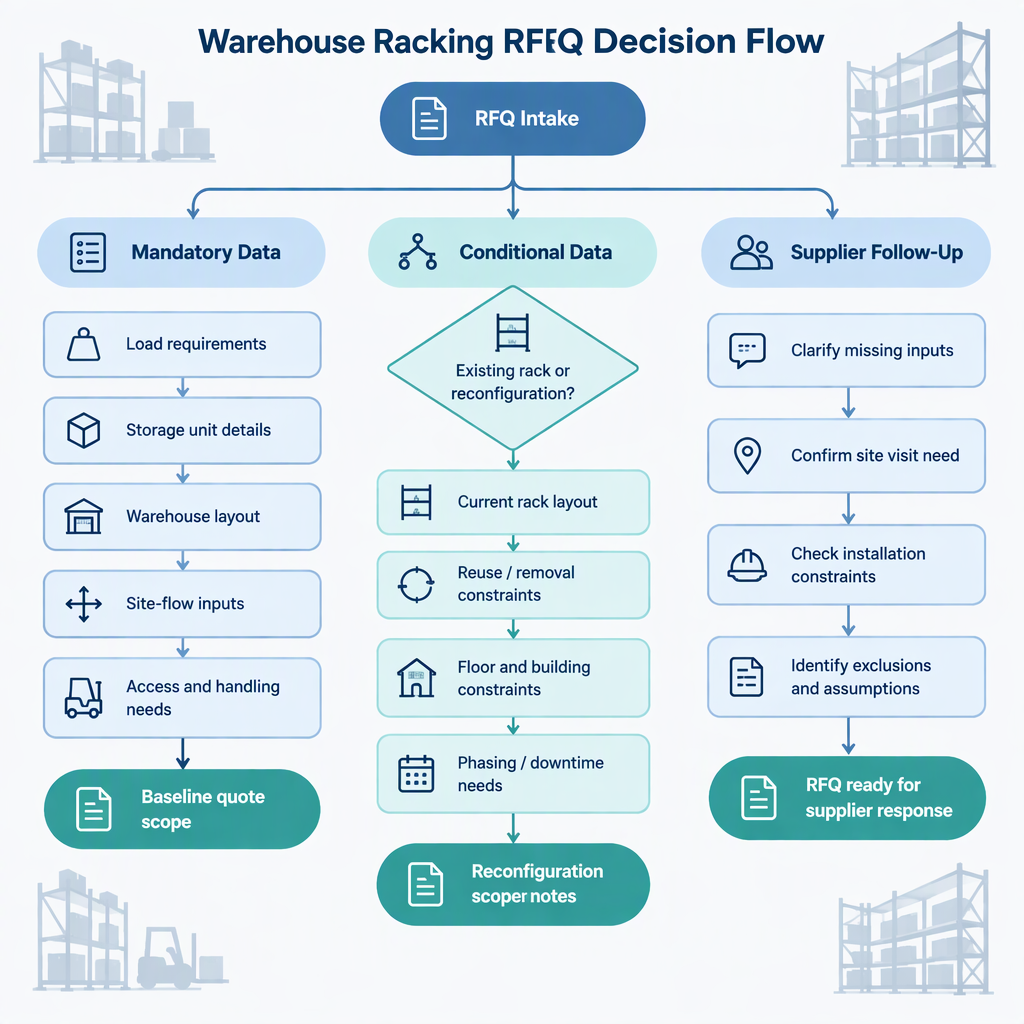
| RFQ data group | Priority | Why it matters | Buyer action |
|---|---|---|---|
| Maximum pallet loads, pallet dimensions, loading method, and load stability | Mandatory | Rack risk can be tied to overloading and unsafe loading practices. | Verify the heaviest current and expected loads before requesting a layout. |
| Floor plan, clear height, columns, doors, equipment paths, and emergency access | Mandatory | Warehouse planning should account for mechanical handling, site transport, working conditions, and emergency procedures. | Send drawings, photos, and marked-up routes rather than only total floor area. |
| Inspection reports, damage photos, repair history, and load notices for existing racks | Conditional | Existing-rack projects need condition information before reuse or reconfiguration is treated as a normal quotation item. | Collect records first and ask what further inspection is required. |
| Workflow preferences, picking zones, staging areas, and future expansion assumptions | Supplier clarification | These details affect layout tradeoffs around access, transport, and operation. | Label assumptions clearly so suppliers can confirm or challenge them. |
Before you send the RFQ: internal verification steps
Before contacting suppliers, align operations, safety, maintenance, and procurement on the facts that the racking layout must respect.
- Confirm load data with operations. Check the maximum pallet weight, pallet format, load stability, and loading method against real warehouse practice.
- Walk the site. Verify drawings against columns, doors, obstructions, traffic routes, emergency access, and active handling-equipment paths.
- Review existing racks. Gather inspection records, damage notes, repair documents, and photos before asking for reuse or reconfiguration pricing.
- Separate facts from preferences. Mark which items are fixed constraints and which are operational preferences that can be discussed with suppliers.
- Check local requirements. Ask the responsible site team, insurer, engineer, or local authority which rules and documentation apply before treating any supplier layout as final.
- Do not hide uncertainty; if a value is estimated, label it as an estimate and ask the supplier what must be confirmed.
- Do not approve a layout only because it maximizes pallet count; review transport, access, maintenance, emergency routes, and daily workflow.
- Do not assume existing racks are suitable for new loads or new locations without condition review and the additional checks required for your site.
Conclusion: turn the checklist into a cleaner supplier brief
A stronger warehouse racking RFQ gives suppliers a verified operating picture, not just a request for rack prices.
For procurement, the practical goal is to remove avoidable assumptions around load, use, maintenance, and loading practice before layout work begins.
For operations, the goal is to show how the warehouse actually moves goods, people, and equipment so storage density does not override access, transport, and emergency considerations.
- Ask each supplier what information is still missing before they finalize layout assumptions.
- Request a clear list of exclusions, assumptions, and site checks required before order placement.
- Keep local engineering, workplace-safety, insurer, and authority requirements separate from supplier marketing claims.
FAQs about warehouse racking RFQs
These quick answers help procurement teams decide what to clarify before asking suppliers for warehouse racking quotations.
What is a warehouse racking RFQ?
A warehouse racking RFQ is a supplier request package that describes the storage need, site constraints, handling equipment, traffic flow, and operating context so vendors can prepare a more accurate quotation and layout discussion.
Can I request a quote with only the warehouse size?
You can ask for an early discussion, but a reliable layout needs more than floor area because load weight, loading practice, rack use, maintenance context, and equipment movement can affect the review.
Which load information is most important?
Start with maximum pallet weight, pallet dimensions, load height, load stability, overhang, and loading direction because overloading and unsafe loading practices are recognized rack-safety concerns.
What building data should I include?
Include a floor plan, clear height, column grid, doors, dock areas, fixed obstructions, equipment paths, emergency access routes, and any zones that must remain open for operations or maintenance.
What if existing racks will be reused or moved?
Send inspection records, damage photos, repair history, load notices, drawings, and relocation history, then ask what additional inspection or engineering review is needed before reuse is considered.
Should I include forklift or handling-equipment information?
Yes. Mechanical handling and site transport are part of warehouse operating context, so equipment type, lift height, travel paths, and turning constraints should be included when they affect aisle and rack layout.
Can one RFQ checklist cover every country?
One checklist can organize the procurement data, but legal and safety requirements must be confirmed for the site’s jurisdiction, adopted codes, insurer requirements, and internal engineering procedures.
What should I ask suppliers after sending the RFQ data?
Ask suppliers to identify assumptions, missing data, required site checks, load limits, existing-rack inspection needs, and documents needed before final quotation or layout review.


