   (+86)-025-86106536                       (+86)-13705159108
Home » News » WMS vs. WCS: Defining Responsibilities Before System Integration

WMS vs. WCS: Defining Responsibilities Before System Integration

Views: 0     Author: Site Editor     Publish Time: 2026-11-19      Origin: Site

Inquire

facebook sharing button
twitter sharing button
line sharing button
wechat sharing button
linkedin sharing button
pinterest sharing button
whatsapp sharing button
sharethis sharing button

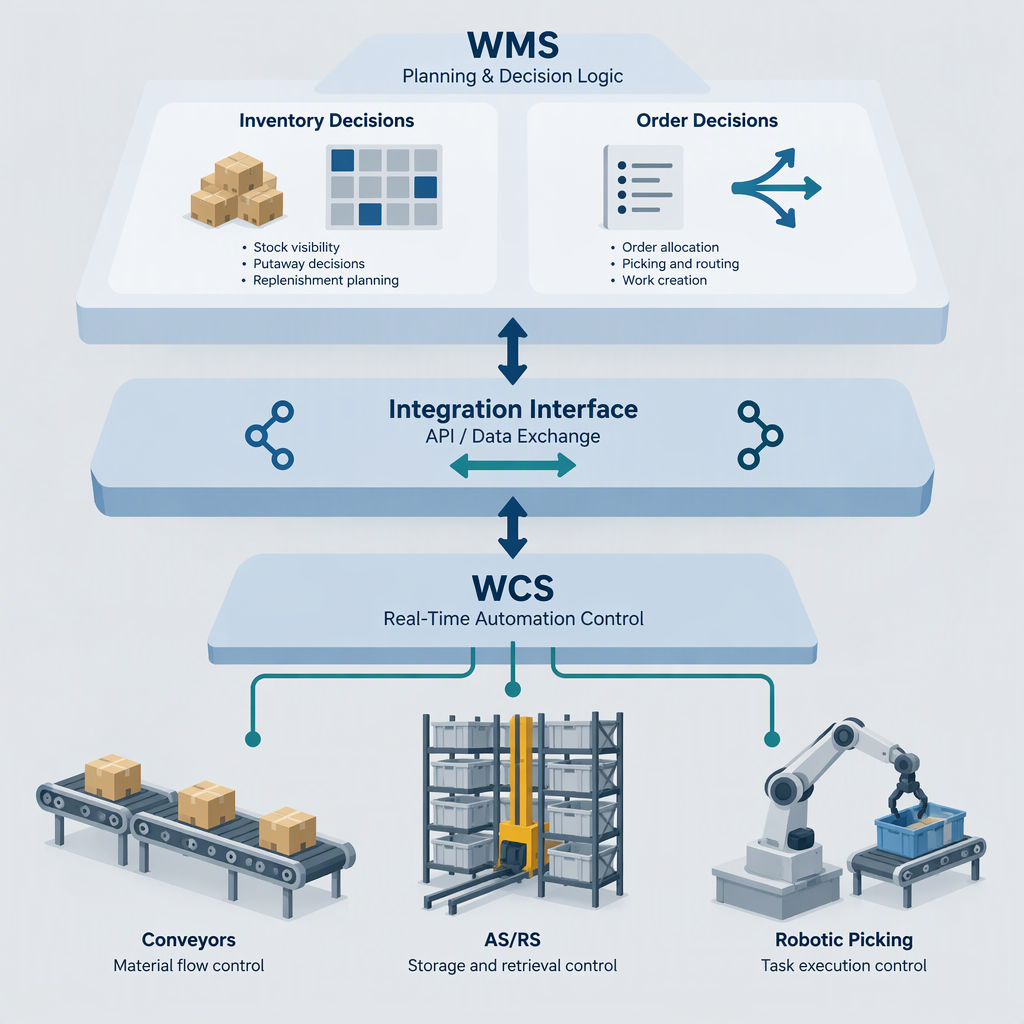
Conceptual warehouse software layers linking inventory decisions with automation control

WMS vs WCS responsibility boundary

The practical difference is that the WMS organizes warehouse inventory, orders and storage logic, while the WCS translates approved work into real-time instructions for automated equipment such as conveyors, AS/RS and robotic picking systems.

WMS owns business-level warehouse control

A WMS is commonly used to control the movement and storage of materials inside a warehouse, including inventory visibility, order management and storage decisions. In the responsibility matrix, place order intent, inventory status and warehouse-process rules here.

WCS owns equipment-level execution

A WCS bridges WMS or ERP directions to automation assets and manages real-time task direction, data flow and machine performance for material-handling equipment. In the responsibility matrix, place equipment sequencing, routing and automation feedback here.

For reader verification on the WCS role, MHI describes a warehouse control system as a bridge between higher-level systems and automated warehouse equipment.

Side-by-side comparison: what each system should own

A useful WMS vs WCS comparison assigns stable business records to the WMS, time-sensitive automation actions to the WCS, and interface rules to a jointly governed integration layer.

Decision area WMS responsibility WCS responsibility Integration responsibility
Inventory and orders Maintain inventory, order and storage context for warehouse operations. Receive executable work intent rather than becoming the inventory system of record. Define which fields are authoritative and how exceptions are returned.
Automation tasking Release work according to business rules and warehouse priorities. Direct automation equipment, manage task flow and coordinate machine-level activity. Agree message timing, status codes, retries and escalation ownership.
Performance monitoring Track process goals and operational KPIs that matter for rollout planning. Report equipment status, automation feedback and machine-performance signals. Map operational KPIs to technical events without creating duplicate dashboards that disagree.
Change control Own warehouse-process changes, master data readiness and user training requirements. Own automation-control changes that affect equipment behavior. Use a shared change log for interface, data and testing impacts.

MHI’s comparison of WMS, WCS and WES is useful for this high-level role separation, but each project still needs its own responsibility matrix.

Where to draw the handoff line

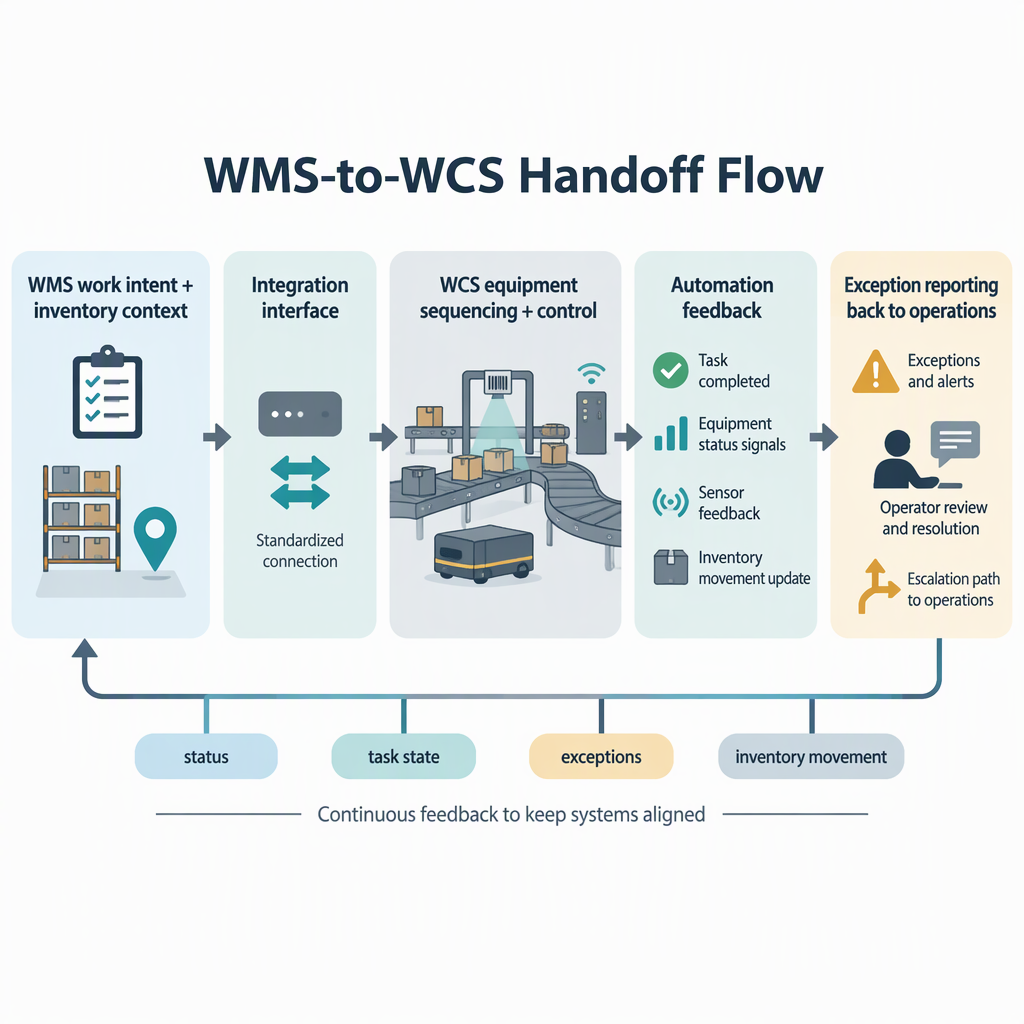
Draw the handoff where business intent becomes equipment execution: the WMS should tell the operation what needs to happen, and the WCS should decide how automation performs the real-time equipment sequence.

Qualitative flow from WMS work intent through integration to WCS equipment control and feedback
Handoff question Assign to Why it matters
Which order or inventory record is authoritative? WMS Inventory and order control belong in the warehouse-management layer.
Which conveyor, AS/RS or robotic move happens next? WCS Real-time automation sequencing belongs in the control layer closest to equipment.
How are task status, faults and completions returned? Shared interface The WCS manages data flow from equipment, but the WMS needs usable status for warehouse decisions.
Who changes priorities during a shift? Defined by process design before rollout Rollout planning should address processes, KPIs, timing and implementation roles before go-live.

When WES enters the conversation

Treat WES as a scope discussion, not as an automatic replacement for WMS or WCS, because vendors may position WES with different mixes of warehouse-management and control functions.

For selection teams, the safe approach is to compare required functions rather than labels: inventory authority, work release, automation routing, exception management, analytics, user permissions and support ownership.

Integration readiness checklist

Before integration starts, confirm the current process, master data, KPIs, timeline, implementation team, customization needs, integration points, training plan and post-go-live support path.

  • Map the current receiving, storage, picking, replenishment, packing and exception processes before software design begins.
  • Define KPIs and go-live timing so testing measures the intended operation rather than isolated software screens.
  • Name the implementation team members who can approve process, data, integration and training decisions.
  • Identify customization, budget, data-accuracy and latency risks before interface development begins.
  • List all automation assets the WCS must coordinate, such as conveyors, AS/RS equipment or robotic picking systems, where applicable to the project.
  • Plan training and post-go-live support so users know how to report system, process and equipment exceptions.

MHI’s guidance on rolling out a WMS highlights planning, process understanding, implementation team structure, integration, data accuracy, training and post-go-live support as rollout concerns.

Procurement matrix for supplier scope

Procurement should ask each software, controls and automation supplier to sign off on a responsibility matrix before commercial scope is frozen.

Procurement line item Question to ask Preferred output
System of record Which platform owns inventory, order and storage records? A named owner and data-field list.
Equipment control Which platform controls real-time automation movement and machine feedback? A named WCS or controls owner.
Interface delivery Who designs, tests and supports each integration point? An interface responsibility matrix with acceptance criteria.
Training and support Who trains users and supports post-go-live issues? A support path separated by process, software and equipment issue type.
  • Request function-by-function scope, not only module names.
  • Ask suppliers to identify exclusions and dependencies in writing.
  • Include test responsibilities in the purchasing scope, not only installation tasks.
  • Keep performance, ROI and throughput commitments out of the scope unless they are backed by project-specific assumptions and acceptance tests.

Testing and go-live responsibilities

Testing should prove that process rules, data accuracy, interface behavior, equipment feedback, user training and support escalation work together before go-live.

  1. Confirm the process baseline. Test against the warehouse process and KPIs approved for rollout.
  2. Validate data quality. Check item, location, inventory and order data before blaming interface behavior.
  3. Run interface and automation scenarios. Confirm that WMS work intent reaches the WCS and that automation status returns in a usable form.
  4. Include user acceptance and training. Let operations users test realistic exceptions and confirm escalation paths.
  5. Plan post-go-live support. Assign owners for software, process, data and automation issues before the first production shift.

Conclusion

The WMS vs WCS decision is not about choosing a winner; it is about drawing a clear operating boundary before integration work begins.

  • Keep inventory, order and storage authority in the WMS scope.
  • Keep real-time automation sequencing and equipment feedback in the WCS scope.
  • Use readiness, testing, training and support planning to reduce integration ambiguity before go-live.

FAQs about WMS vs WCS

These questions help warehouse planning, logistics operations and engineering procurement teams turn the comparison into a working integration scope.

Should a project choose WMS or WCS first?

Start with the warehouse process, KPIs, rollout plan and integration needs, then decide which WMS and WCS responsibilities are required. The order of procurement should follow the operating design, not the acronym.

Can a WMS directly control automation equipment?

A WCS is commonly used to bridge WMS or ERP directions to automated equipment and to manage real-time control tasks, so direct equipment-control expectations should be checked carefully before assigning them to the WMS.

What data should pass between WMS and WCS?

Typical interface planning should cover work intent from the WMS, equipment execution status from the WCS, exception messages, completions and the data needed for warehouse decisions.

Does WES replace WMS and WCS?

Not automatically. WES may include aspects of WMS and WCS depending on the vendor, so buyers should compare included functions, exclusions and interface ownership.

What should procurement put in the supplier scope?

Procurement should request a written responsibility matrix covering process ownership, customization, integration, testing, data accuracy, user training and post-go-live support.

What is the biggest go-live risk in WMS and WCS integration?

A common risk is unclear ownership across process, data, integration and support responsibilities. Reduce it by agreeing the rollout plan, implementation team, testing scope and support path before go-live.

Which WMS or WCS vendor is best?

The best choice depends on the project’s process scope, automation design, integration requirements, support model and commercial constraints. Build a requirements matrix before comparing vendors.

China : +86-13705159108

US: +1 269 830 5802

MY:+60 126162998

China : Floor 9, Building 1, Zijinxicheng Center, No. 118 Olympic Gym Str., Jianye, Nanjing, Jiangsu, China 


US: 3702 W Sample Street,South Bend,Indiana,46619  

China:export@nova-china.com 
 
US: Bin@nova-china.com
 
MY:nct@nova-china.com

Quick Links

Products

 Copyrights 2019 NOVA All rights reserved. Sitemap
Technology by Leadong