English



When push-back can stay in the discussion
It can remain on the shortlist when operations can dedicate lanes by SKU, batch, production run, or shipment wave and the team can work within the rotation process documented for the design.
Views: 0 Author: Site Editor Publish Time: 2026-11-15 Origin: Site
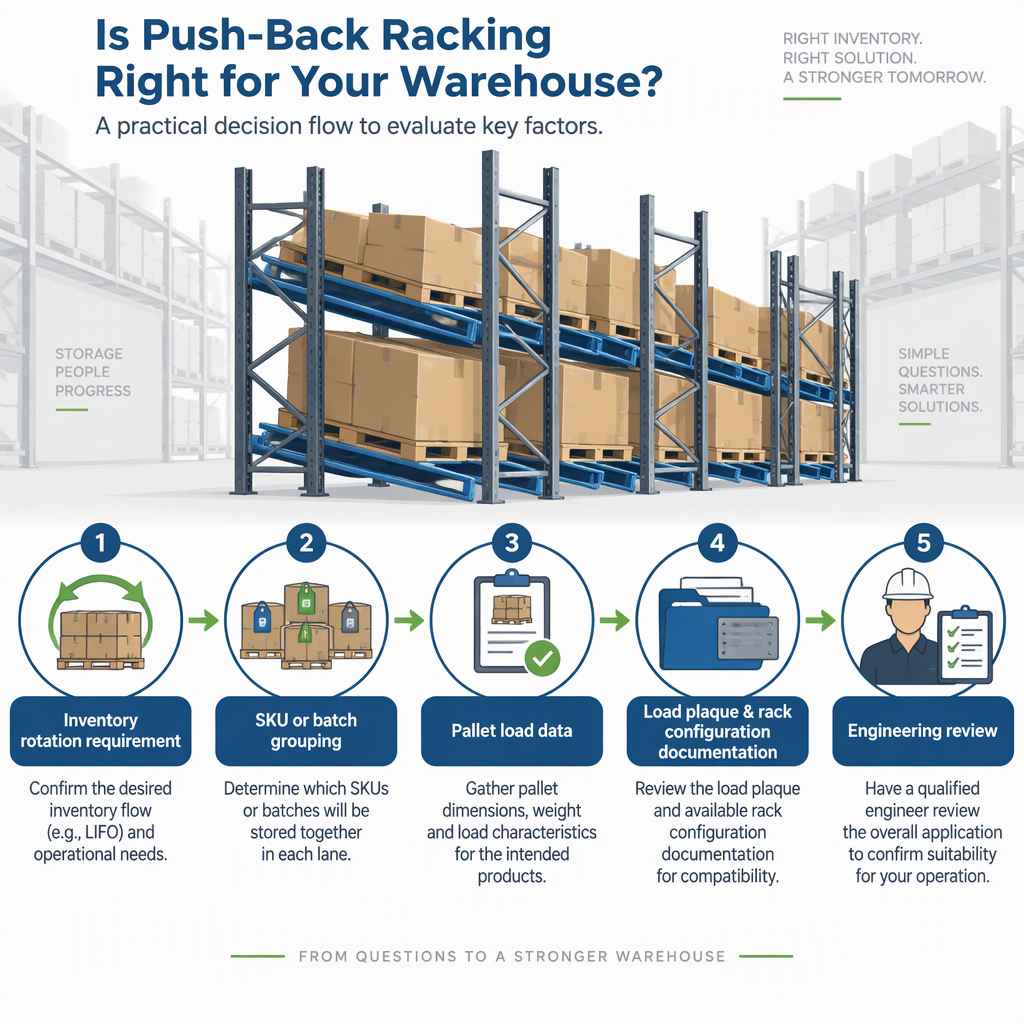
Push-back racking belongs on the shortlist when inventory can be grouped into repeatable pallet lanes, the operation can accept the rotation method confirmed for those lanes, and procurement can require load plaques, documented rack configuration, and engineering review before any configuration change.
Screen push-back racking for inventory patterns that can be assigned to stable lanes by SKU, batch, or pallet family, then confirm the rotation method and load documentation before treating it as a viable design.
| Inventory pattern | Push-back screening result | Buyer check before shortlisting |
|---|---|---|
| Repeated SKU or batch with several pallets available at a time | Often worth screening because lane grouping may reduce aisle demand compared with fully selective layouts. | Confirm whether each lane can stay dedicated long enough to avoid frequent reshuffling. |
| Mixed, low-quantity SKUs with high pick-face variety | Use caution; frequent SKU changeovers can weaken the case for deep lane storage. | Compare the operational value of direct pallet access against storage density goals. |
| Strict date-code or lot rotation requirement | Do not assume fit from rack type alone. | Require the supplier to document the intended lane rotation process and operating limits. |
| Changing pallet weights, heights, or load styles | Keep the design conditional until the rack load documentation is reviewed. | RMI states that load capacity plaques for storage rack systems should document information such as maximum permissible unit load, maximum load per level, maximum total load per bay, and storage elevation information. |
For an application-selection discussion, avoid choosing push-back racking by storage density alone. The practical question is whether the inventory pattern can remain orderly by lane while still meeting rotation, replenishment, and safety documentation requirements.
Treat rotation as a design constraint, not an assumption: if strict first-in/first-out control is mandatory, require a documented method before selecting any lane-based storage approach.
It can remain on the shortlist when operations can dedicate lanes by SKU, batch, production run, or shipment wave and the team can work within the rotation process documented for the design.
If every pallet must be independently accessible, if date-code discipline is the dominant requirement, or if SKU mixing changes daily, compare selective, flow, or other rack types before committing to push-back.
Do not use informal labels such as “FIFO compatible” or “high-density” as approval criteria. Ask how pallets enter, how they leave, how exceptions are handled, and what the operator must do when a lane contains a partial batch.
Before requesting a push-back rack proposal, collect inventory rotation rules, SKU grouping logic, pallet dimensions and weights, load variation, planned storage elevations, and the documentation needed to confirm the rack configuration.
For load documentation, RMI describes load capacity plaques as a way to communicate permissible unit load, level load, bay load, and storage elevation information for rack users. Confirm the governing standard edition and any project-specific requirements with the qualified rack designer.
Push-back racking should not be approved for a changing inventory profile unless the buyer has a controlled process for load plaques, rack drawings, and qualified review of configuration changes.
RMI says owners should check load application and rack configuration drawings before changing rack configurations, and should consult the original rack manufacturer or a qualified rack design engineer when the desired configuration is outside the documented options.
RMI also states that ANSI MH16.1 section 4.5 governs storage rack load capacity plaques and describes plaque content for communicating load limits and storage elevations. Confirm the edition and local project requirements with the responsible engineer before procurement approval.
The risk is not only whether the first layout works. The larger procurement risk is approving a layout that later receives heavier pallets, taller pallets, different load profiles, or undocumented elevation changes without a fresh engineering check.
Compare push-back against alternatives by inventory rotation, SKU concentration, access needs, and documentation controls rather than by a single density claim.
| Rack choice to compare | When it may fit better | Question for the buyer |
|---|---|---|
| Selective racking | When every pallet position needs direct access or SKU variety is high. | Is access flexibility more valuable than lane-based storage density? |
| Drive-in or drive-through style storage | When large blocks of similar inventory can be stored with controlled access patterns. | Can operations manage deep-lane discipline without frequent SKU mixing? |
| Pallet flow or other rotation-focused systems | When the dominant requirement is a defined pallet movement sequence. | Does the inventory require a documented rotation path from storage to picking or shipping? |
| Push-back racking | When repeated pallet groups can be assigned to lanes and the supplier-confirmed operating method matches the inventory rule. | Will any future configuration change be checked against rack drawings and reviewed by the original manufacturer or a qualified rack design engineer when outside documented options? |
A useful comparison table should lead to an engineering brief, not a final design. Keep numeric lane depths, load ratings, bay capacities, and price comparisons out of the decision until they come from the project-specific rack proposal.
Procurement should ask for the proposed rack configuration, load information, plaque content, operating assumptions, and the change-control path before approving a push-back racking project.
RMI states that rack load plaques provide operator-visible information for industrial steel storage rack installations, including maximum permissible unit load and maximum total load per bay. That makes plaque content a procurement item, not only a safety-office item.
Push-back racking is a selection candidate when the inventory can be organized into stable lane groups, the rotation rule is acceptable for the operation, and the rack configuration is backed by documented load and change-control information.
For warehouse planning managers, logistics operations managers, and engineering procurement teams, the practical next step is to prepare an inventory-pattern brief before asking for a proposal. Include SKU grouping, pallet load data, rotation requirements, expected change scenarios, and the documentation you expect with the rack design. If those inputs are unclear, compare alternative rack systems first instead of forcing push-back into an unsuitable inventory structure.
These questions help buyers turn the push-back racking shortlist into a controlled engineering discussion.
No. It should be screened against inventory rotation, SKU concentration, pallet consistency, and rack documentation needs. Warehouses with highly mixed, low-volume SKUs may need more direct access than a lane-based approach provides.
Do not assume it can. If FIFO or strict date-code rotation is mandatory, require the supplier or engineer to document how the proposed design will preserve the required sequence.
Start with SKU grouping, pallet footprint, pallet height, unit load weight, rotation rules, batch controls, and expected future changes. Those inputs shape whether a lane-based layout is practical.
Load plaques matter because RMI states that industrial steel storage rack installations require one or more load plaques and that the plaques communicate information including maximum permissible unit load and maximum total load per bay.
Treat the change as an engineering review trigger. RMI says rack owners should use load application and rack configuration drawings and consult qualified rack design support when a desired configuration differs from documented options.
No. Ask for lane depth, load rating, and configuration only after the supplier has the inventory pattern, pallet data, and rotation requirements. Otherwise the number can become a guess rather than a project-specific design parameter.
Exclude unverified capacity, certification, audit, delivery, price, and performance claims unless the supplier provides formal project documents supporting them. The approval memo should rely on documented design inputs and reviewed rack information.