(+86)-025-86106536 (+86)-13705159108

 English
- All
- Product Name
- Product Keyword
- Product Model
- Product Summary
- Product Description
- Multi Field Search
Views: 0 Author: Site Editor Publish Time: 2026-06-11 Origin: Site
You should know the main differences between structural vs. roll formed pallet racking. Structural racks use strong steel beams and bolts to connect, providing enhanced durability. In contrast, roll formed racks feature lighter beams with slots for easy adjustments. Choosing the right type of racking is essential for maintaining safety and efficiency in your warehouse operations. Safety tools like guard rails, sensors, software, rack end guards, and column guards help protect your team and equipment:
Safety Feature | Description |
|---|---|
Guard Rail Systems | These are barriers in places where accidents can happen. |
Sensors | These warn you when forklifts get close. |
Warehouse Software | This helps keep track of inventory and checks for safety problems. |
Rack End Guards | These take hits so traffic can move safely. |
Column Guards | These protect the upright columns from getting damaged. |
Nova Intelligent is a leader in smart logistics and racking solutions, with over 25 years of experience. You can trust Nova to help your warehouse operate at its best.
Structural racks are made with tough steel and bolts. They last a long time and hold heavy things well.
Roll formed racks are not as heavy. They can bend and change shape easily. They are simple to move and cost less money.
Safety tools like guard rails and sensors help keep the warehouse safe. They also make work faster and better.
Think about how much weight the racks can hold. Also, look at the price and how easy they are to change. This helps you pick the best rack.
Nova Intelligent gives smart help for the best warehouse racks.
It is important to know the basics before picking a pallet rack. Structural and roll formed pallet racking are two main types. Each type has special features that change how you use your rack and how your warehouse works.
Structural pallet racks are made with hot-rolled steel. You use bolts to connect the beams to the uprights. This makes the rack very strong and able to hold heavy things. You can move the shelves if you need to. Structural racks are good when you need something tough and strong.
Roll formed pallet racks use cold-rolled steel. The beams and posts have holes punched in them. You use clips or hooks to attach the beams. This makes the rack lighter and easier to move around. Roll formed racks are flexible and cost less money. You can change them quickly if you want.
Selective pallet racking can be either structural or roll formed. Structural racks can hold more weight and are easier to change.
Choosing between structural and roll formed pallet racking is important for your warehouse. Structural racks last longer and can take more use. Roll formed racks are lighter and simple to put together. You should think about what you need before you pick a pallet racking system.
Nova Intelligent is a top company in this field. You get help from their experience and leadership. Nova has won awards like the 2024 Logistics Well-known Brand (Shelf) Award and the 2024 Logistics Well-known Brand (Shuttle Car) Award. Nova’s pallet rack solutions help you store things safely and efficiently.
You can use a table to compare structural and roll formed pallet racking. This lets you see the main differences quickly.
Feature | Structural Racking | Roll-Formed Racking |
|---|---|---|
Manufacturing Process | Hot-rolled steel for superior strength | Cold-rolling for complex shapes, lighter duty |
Load Capacity | 3,000 to 20,000+ pounds per pair | 2,500 to 6,000 pounds per pair (standard) |
Upright Capacity | Exceeds 50,000 pounds | 15,000 to 35,000 pounds |
Initial Cost | Higher upfront costs | 15–30% lower upfront costs |
Durability | High durability, withstands heavy use | Requires careful handling, less durable |
Flexibility | Rigid, less adaptable | Highly adaptable, quick reconfiguration |
Installation | Heavier components, more equipment needed | Lighter weight, simpler assembly |
Structural racks cost more at first but last a long time. Roll formed racks cost less and are easier to put together. Picking between structural and roll formed pallet racking changes your budget, how long it lasts, and how easy it is to change.
You also need to think about cost, how long it lasts, and how fast you can install it:
Aspect | Structural Racking | Roll-Formed Racking |
|---|---|---|
Cost | Higher initial investment but potentially lower long-term costs due to durability | Lower initial costs due to manufacturing efficiency and reduced material use |
Durability | Superior durability with hot-rolled steel and bolted connections | Durable for intended applications but more susceptible to impact damage |
Installation | Heavier components require more equipment and time | Lighter weight and simpler assembly reduce installation time and costs |
You need to pick the pallet rack that fits your warehouse best. Structural and roll formed pallet racking give you choices for strength, price, and flexibility. Nova Intelligent helps you find the best pallet racking system. You get expert advice and proven ways to store your pallets and racks.
Structural racking is used in many warehouses. It is made with strong materials and careful steps. The process starts with steel coils that are very strong. These coils must meet strict rules for holding heavy loads. This makes racks that can hold lots of weight and take hits. Here are the main steps:
Raw Material Selection: High-tensile steel is picked for strength and lasting power.
Profiling Process: Machines shape steel into columns and beams. Punching machines make slots for adjustments.
Welding Process: Robots weld the parts together. Inspections check the welds to make sure they are good.
Structural racking uses steel rack parts. This makes the rack tough and dependable. You get a system that lasts a long time.
Structural racking is used where strength is needed most. Many industries use structural racks for heavy loads and busy areas. Here are some common uses:
Warehouses: Heavy materials are stored and vertical space is used.
Manufacturing Facilities: Raw materials and finished goods are organized.
Retail Stores: Backstock merchandise is kept safe and neat.
Distribution Centers: Racks resist forklift hits and handle fast-moving items.
Structural rack systems use thick steel. Parts are bolted together for extra strength. These racks are good for busy places and big items.
You want a rack that is reliable and new. Nova Intelligent gives you structural racking with flexible design. You can change your rack easily. Nova’s racks are made to last and have better safety. You get value for a long time and need fewer replacements. Here is a comparison:
Feature | Nova Intelligent's Racking | Competitors' Racking |
|---|---|---|
Innovation | Flexible modular design | Not much customization |
Reliability | Made for durability | Depends on maker |
Safety | Better safety features | Sometimes not tested |
Adaptability | Easy to change | Needs new systems |
Cost-effectiveness | Good long-term value | Needs more replacements |
Nova Intelligent’s structural racking helps make your warehouse safer and stronger. You get expert help and proven ways to store your things.
Roll formed racking is common in many warehouses. Manufacturers use cold rolled steel to make the parts. Machines shape the steel into beams and uprights. Holes are punched in the steel for shelf adjustments. This process makes racks lighter than structural racks. These racks are easy to move and install. The lighter steel makes roll formed racking flexible. You can change the layout fast. Modern roll formed racks use strong steel. They work well for most warehouse needs.
Tip: Roll formed racking uses lighter materials. This makes it easy to handle. But it can dent or bend if overloaded. Only use it for loads that fit its design.
Roll formed racking is best for light or medium storage. It is used where layouts change often. Selective pallet racking is the most popular type. You get direct access to every pallet. This helps manage many SKUs and fast product changes. Roll formed racking fits warehouses and e-commerce centers. It works well for places with moderate product movement. You can adjust the beams for different products. Roll formed racks are a good choice for general warehousing.
Common uses for roll formed racking:
General warehousing
E-commerce fulfillment
High SKU variety, moderate throughput
Pick roll formed racking when you need flexibility. You get a rack that adapts to your needs.
Nova Intelligent offers roll formed racking with high standards. The racks use advanced cold rolled steel. Nova’s racks are easy to install and adjust. You can change the layout as your business grows. Nova’s roll formed racks help you store products safely. You get expert support and proven designs. Nova has completed thousands of projects for many clients. You can trust Nova to deliver the right racking for your warehouse. Nova’s racks help you improve storage and keep things running smoothly.
Feature | Nova Intelligent Roll Formed Racking | Typical Roll Formed Racking |
|---|---|---|
Material Quality | Advanced cold rolled steel | Standard cold rolled steel |
Flexibility | High, easy to reconfigure | Moderate |
Installation | Fast and simple | Simple |
Safety | Enhanced features | Standard |
You get roll formed racking that helps your business and keeps your warehouse efficient.
When you look at a structural racking system, you see strong steel parts. The beams connect to the upright columns using bolts. This bolted connection gives the rack extra strength. You use tools to tighten the bolts, which makes the rack very stable. If you need a rack that can handle heavy loads or frequent forklift traffic, this type of racking works well. The bolted beams do not move or shift easily. You can trust the rack to stay in place, even in busy warehouse areas.
Note: Bolted connections make the rack more rigid. You get a racking system that stands up to impacts and heavy use.
Here is a quick look at the main connection methods:
Type of Racking | Beam Connection Method |
|---|---|
Structural Pallet Racking | Bolted connections for rigidity |
Roll Formed Pallet Racking | Clip-in or drop-in connections for quick assembly |
You may notice that assembling a structural rack takes more time. You need to line up the beams and tighten each bolt. This careful process helps the racking last longer and keeps your warehouse safe.
Roll formed racking uses a different method. The beams have special clips or hooks. You slide the beam into the upright and the clip locks it in place. This design lets you build the rack quickly. You do not need many tools. If you want to change the rack layout, you can move the beams up or down with little effort. This makes roll formed racking a good choice for warehouses that need to adjust storage often.
The assembly time for roll formed racking is much shorter than for structural racking. You can see the difference in this table:
Pallet Racking Type | Assembly Time Comparison |
|---|---|
Structural Racks | Requires 66% more time than roll formed racks |
Roll Formed Racks | Quicker assembly process |
You save time when you use roll formed racking. You can set up a new rack or change an old rack in less time. This helps you keep your warehouse running smoothly.
Tip: If you need to change your rack setup often, roll formed racking gives you the flexibility you want.
Both types of racking have their own strengths. You should choose the rack and racking system that fits your warehouse needs best.
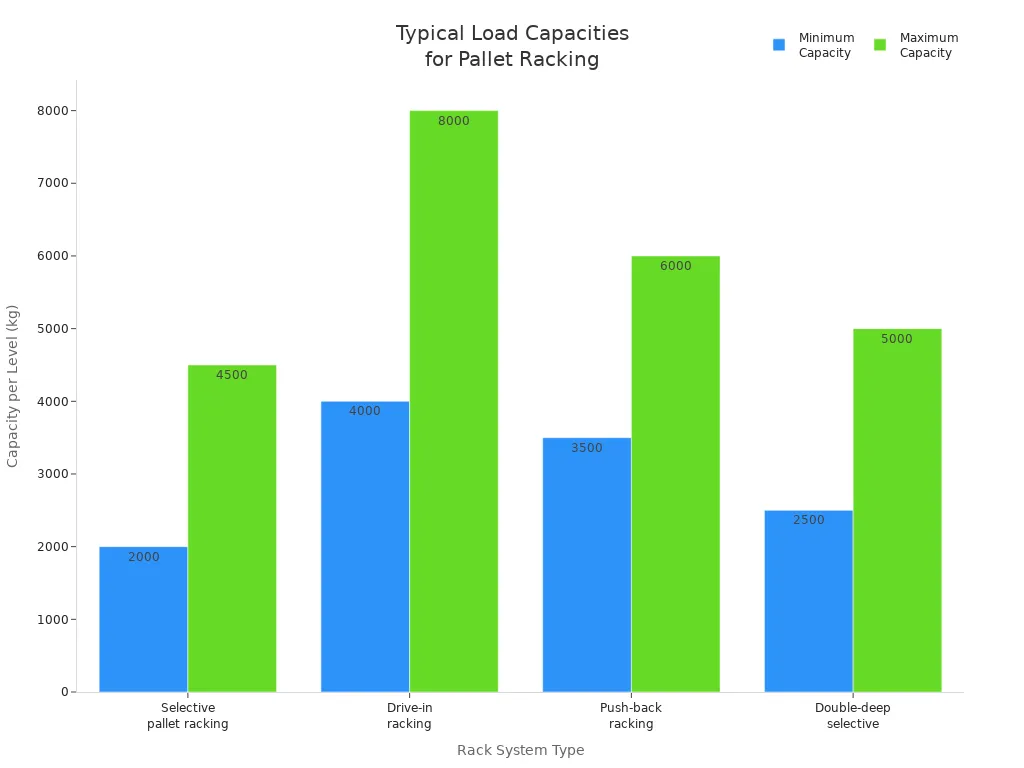
You want racks that hold heavy pallets and keep people safe. Structural racking gives strong support and stays steady. Makers use thick steel to build these racks. Each rack can hold thousands of kilograms on every level. Bolted connections make the rack even stronger. These racks work well in busy places and tough spots.
Here is a table that shows how much weight different racks can hold:
Rack System Type | Typical Capacity per Level | Common Applications |
|---|---|---|
Selective pallet racking | 2,000–4,500 kg | General warehousing, distribution |
Drive-in racking | 4,000–8,000 kg | High-density, same-SKU storage |
Push-back racking | 3,500–6,000 kg | LIFO inventory management |
Double-deep selective racking | 2,500–5,000 kg | Increased density, reduced access |
These racks last for many years. Structural racking can handle lots of loading and unloading. Every part of the rack is made to be strong. The rack does not dent or bend easily. You can count on these racks to stay safe and steady.
Made from thick steel parts.
Built with strong methods for better durability.
Handles loading and unloading many times without damage.
Gives safe storage for years in busy places.
Roll formed racking is easy to change and move. It uses lighter materials for each rack. These racks are good for medium loads and changing setups. The design is strong, but it can dent or bend more easily. You can move the shelves fast for new products.
This rack holds lighter pallets. It works well for regular warehouses and online stores. The rack is strong enough for daily use. You should not put too much weight on it. The rack may not do well with very heavy loads. It is less steady if things hit it hard.
Here is a table to compare both types:
Feature | Structural Pallet Racking | Roll Formed Pallet Racking |
|---|---|---|
Material | Heavy-duty steel components | Lighter-weight materials |
Durability | Higher resistance to wear and tear | More susceptible to dents or bends |
Construction Method | Robust construction methods | Standard construction methods |
Load Handling | Designed for heavy loads without compromising safety | May struggle under extreme loads |
Stability | Exceptional long-term stability | Less stable under high-impact activities |
Suitability for High Traffic | Ideal for high-traffic warehouse operations | Suitable but less durable in high-traffic areas |
Pick roll formed racking if you need to change your setup often and do not need to store very heavy things. These racks help you keep products neat and your warehouse running well.
You get many advantages when you choose structural racking for your warehouse. This type of rack uses strong steel and bolted connections. You can trust the rack to hold heavy loads and stay stable. You see these racks in places where forklifts move often and where safety matters most.
You enjoy high durability. The rack stands up to impacts and daily use.
You can store heavy pallets. The racking supports large weights without bending.
You get a long-lasting solution. The rack resists wear and tear for many years.
You see fewer repairs. The racking needs less maintenance because of its strong build.
You can use the rack in tough environments. It works well in cold storage, manufacturing, and busy distribution centers.
Tip: Structural racking gives you peace of mind. You know your warehouse stays safe and efficient.
Roll formed racking offers advantages for warehouses that need flexibility and cost savings. You can change the rack layout quickly. The racking uses lighter materials, so you move and install it with ease. You save money and time when you pick this rack.
You spend less on the rack. Roll formed racking costs less per unit than structural racking.
You install the rack faster. Lightweight parts make assembly simple.
You adjust the racking easily. The modular design lets you change shelf heights and layouts.
You use the rack for light to medium-duty storage. It fits warehouses with changing inventory needs.
You benefit from a cost-effective solution. The racking adapts to your business as it grows.
Note: Roll formed racking helps you keep up with fast-moving products and frequent changes in your warehouse.
You need to know the disadvantages of each rack type before you make a choice. Every racking system has limits. You must match the rack to your warehouse needs.
Rack Type | Disadvantages |
|---|---|
Structural Racking | Higher upfront cost. Heavier parts make installation harder. Less flexibility for quick changes. |
Roll Formed Racking | Lower strength for heavy loads. More risk of dents or bends. Not ideal for high-impact areas. |
Structural racking costs more at first. You need special tools and more time to install the rack. You cannot change the racking layout quickly.
Roll formed racking does not handle heavy pallets as well. The rack may bend if you overload it. You see more damage in busy warehouses.
Callout: You should weigh the advantages and disadvantages of each rack. Think about your warehouse size, product weight, and how often you change your racking layout.
You make the best choice when you understand the advantages and disadvantages of structural and roll formed racking. You get a rack that fits your business and keeps your warehouse safe.
You want to pick the best racking for your warehouse. There are several things you should think about before making a choice. Every warehouse has its own storage needs. You need to match your racking to what you want to store.
Here is a table that shows how structural and roll formed pallet racking compare for warehouse storage:
Factor | Structural Pallet Racking | Roll-Formed Pallet Racking |
|---|---|---|
Durability | Exceptional strength, resists forklift damage | Thinner steel, more likely to get damaged |
Load Capacity | 3,200 to over 12,000 pounds | 2,000 to 3,000 pounds, lower capacity |
Installation | Takes more time and labor | Quick and easy to install |
Cost | Higher upfront, long-term investment | Lower, good for standard storage |
Adaptability | Not easy to adjust | Easy to change and reconfigure |
Recommended Applications | Heavy-duty, harsh warehouse storage applications | Lighter loads, narrow aisles, flexible setups |
Structural racking is good if you need to store heavy pallets. It works well in tough places and busy areas. Roll formed racking is better for lighter loads. You can change and move this racking quickly.
Tip: Think about what you need to store, how often you change your setup, and your budget before picking a racking system.
Nova Intelligent helps many customers find the right storage solutions. Nova has worked with companies all over the world. For example, Toyota in Oman needed strong racks for auto parts. Nova put in heavy-duty racking that could handle big loads and lots of forklift traffic. This made their warehouse safer and better.
JD in Guangzhou wanted racks that could change for e-commerce. Nova used roll formed racking so JD could adjust their storage as products changed. This helped JD manage many SKUs and fill orders quickly. Nine Dragons Paper in Chongqing needed racks for both heavy and light materials. Nova made a custom racking system that fit both needs.
You can count on Nova Intelligent to plan, design, and install the right racking for your warehouse. Nova’s experience helps you get storage that fits your business. You get safe, efficient, and flexible storage every time.
You have learned the main differences between structural and roll formed pallet racking. Structural racks are strong and last a long time. They are good for heavy things. Roll formed racks are easy to change and move. They work well for lighter items. You should pick the rack that fits your warehouse, your money plan, and how often you need to change things. Nova Intelligent can help you choose the best rack for your business.
Contact Nova Intelligent for expert help and custom racking systems that keep your warehouse safe and working well.
Structural racking is made with thick, hot-rolled steel. It uses bolts to hold everything together. This makes it very strong. Roll formed racking is made with lighter, cold-rolled steel. It uses clips so you can change things easily. You pick the type that works best for your warehouse.
You need tools if you want to change structural racking. The bolts make it harder and slower to adjust. Roll formed racking is different. You can move the beams fast and you do not need tools.
Structural pallet racking is better for heavy loads. It is stronger and lasts longer. Roll formed racking is good for lighter things and when you want to change the setup often.
Nova Intelligent gives you expert help and custom plans. You get a racking system that fits your warehouse and your budget. Nova helps you from the start to the finish.