
 English


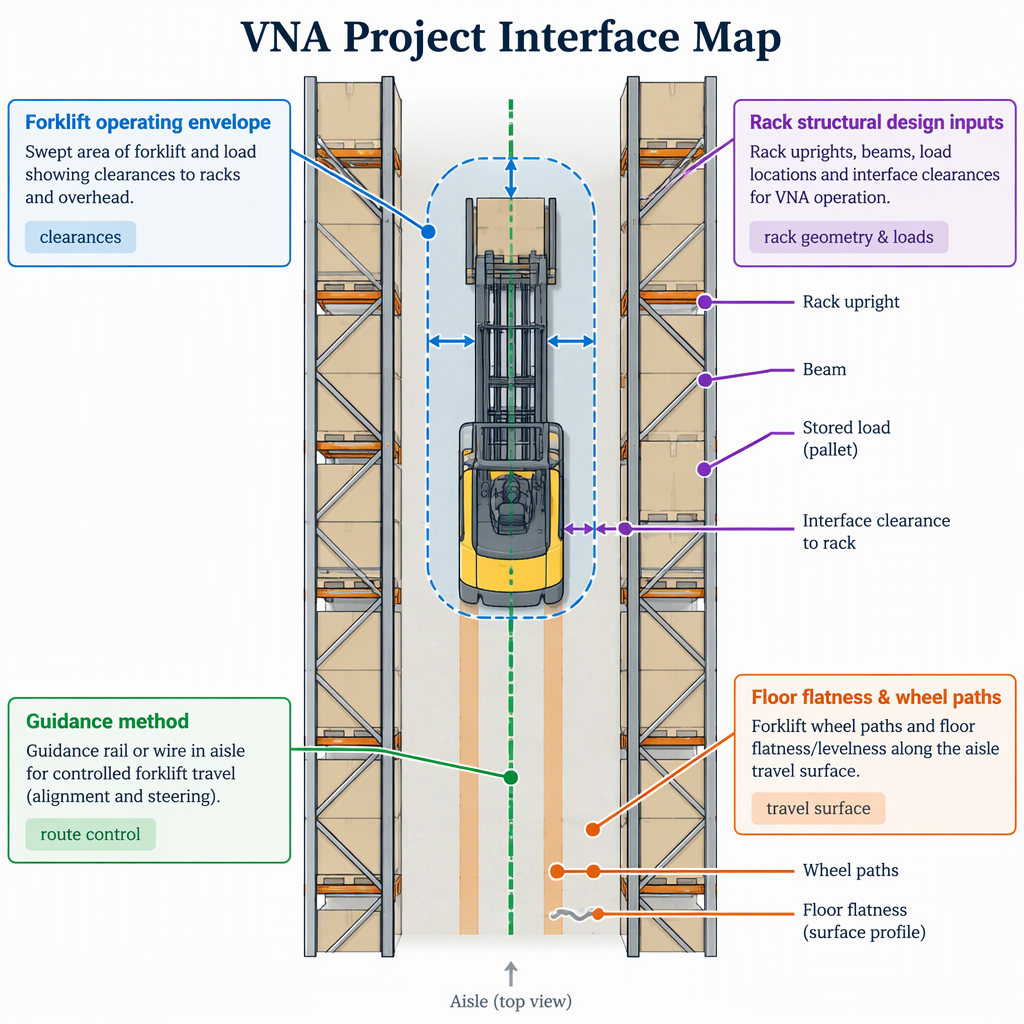
Very narrow aisle racking should be approved only after the forklift supplier, floor specialist, and rack engineer agree on the truck operating envelope, guidance method, floor/wheel-path condition, and rack design inputs. 江苏六维智能物流装备股份有限公司 has a VNA pallet racking product page, but project suitability still depends on the forklift model, floor condition, and documented engineering assumptions.

Confirm the forklift operating envelope before fixing the rack layout
Before the rack layout is frozen, ask the forklift supplier to confirm the truck type, guidance interface, load handling envelope, and aisle behavior that the racking layout must accommodate.
- Request the proposed VNA truck model, mast configuration, load dimensions, attachment assumptions, and required working clearances.
- If the truck will use wire guidance, confirm how the truck sensor interacts with the signal wire in the aisle floor and where the guided path must sit relative to the rack faces.
- Ask whether the truck needs lead-in distance, transfer aisle clearance, battery or charging access, or a defined entry/exit zone that changes the first bay or end-of-aisle design.
- Require written confirmation of the maximum pallet and load envelope used for layout review, rather than designing around a nominal pallet size alone.
Resolve guidance method: wire, rail, or manual entry assumptions
The guidance method affects aisle centerline, floor preparation, truck entry, and rack-protection assumptions, so it should be agreed before procurement documents are released.
| Guidance assumption | Questions for the forklift supplier | Questions for the rack and floor teams |
|---|---|---|
| Wire guidance | Confirm whether the truck uses a sensor to follow a signal from a wire installed in a center groove in the stacking aisle floor. | Confirm the required centerline, installation responsibility, floor cutting constraints, and how the rack layout protects the guided path. |
| Rail guidance | Confirm whether the selected truck and site design will use rail guidance instead of wire guidance. | Confirm rail location, rack-base interaction, upright protection, and floor-fixing details with the responsible engineer. |
| Manual entry or transition zones | Confirm where the operator transitions into the aisle and what alignment space is required. | Confirm whether end bays, guard positions, and transfer aisles need extra review. |
Verify floor flatness and wheel-path requirements
Because VNA trucks repeatedly travel along defined aisle paths, floor condition and wheel-path requirements should be checked before racking approval, not after installation.
Face Consultants describes VNA warehouse applications as defined-movement floors, where specialised material-handling equipment runs along fixed paths and floor profiles in the wheel paths may be surveyed. Review the defined-movement floor explanation from Face Consultants when preparing floor-survey questions.
- Discuss a floor survey before final approval when the truck will follow fixed wheel paths, when the slab condition is unknown, or when the forklift supplier specifies a floor-flatness requirement.
- Ask how measured floor profiles will be reported, who will decide whether corrective work is needed, and whether any grinding or remediation must be completed before truck commissioning.
- Confirm whether the floor review covers the entire building, only the VNA aisles, or the defined wheel paths within each aisle.
- Keep the floor requirement tied to the selected truck and aisle path; do not copy a tolerance from another site without supplier confirmation.
Align aisle path, pallet clearances, and entry zones
The safest procurement sequence is to align the guided aisle path, pallet envelope, rack face, and floor-review scope as one interface rather than as separate drawings.
- Start with the forklift supplier’s selected truck and guidance concept, because a wire-guided truck follows a defined signal path in the aisle.
- Overlay pallet size, load overhang, rack upright location, beam levels, and sprinkler or building constraints on the same layout.
- Mark the wheel paths or defined travel paths that need floor-profile review before final sign-off.
- Hold a joint review with forklift, rack, floor, and operations stakeholders before releasing procurement drawings.
| Interface | Primary question | Who should confirm it |
|---|---|---|
| Truck path | Where does the truck centerline run through each aisle? | Forklift supplier |
| Rack face and pallet envelope | What clearances are needed at operating height and at aisle entry? | Rack supplier and forklift supplier |
| Floor wheel paths | Which floor lines must be surveyed or corrected? | Floor specialist and forklift supplier |
| Operations entry zones | Where do pallets, pedestrians, charging routes, and transfer aisles interact? | Warehouse operations and project engineer |
Set the rack design basis and engineering inputs
The rack supplier should document the design basis and the project inputs used for structural analysis before the purchase order is approved.
| Design input | Why it matters in a VNA project | Procurement action |
|---|---|---|
| Load and storage levels | Storage-level count and loading assumptions affect rack design analysis. | Freeze pallet weights, beam levels, and load cases in the approval package. |
| Beam, column, and connector behavior | RMI describes beam stiffness, column stiffness, and connector stiffness/strength as design-analysis factors. | Ask the rack supplier to identify the assumptions used in the calculation package. |
| Base plates, anchorage, and site conditions | RMI includes base plate and anchorage detail, site seismicity, frame aspect ratio, and environment among analysis inputs. | Coordinate slab information, anchorage limits, and seismic or local project requirements with the engineer. |
RMI’s rack safety article on ANSI MH16.1-2021 calculation examples lists multiple rack-design analysis inputs. Use it as a prompt for engineering questions, while asking your supplier which code or standard edition applies to your project.
Document applicable standards without overstating edition status
Procurement documents should name the standard or code basis that the rack engineer will use, but they should also require the supplier to confirm the applicable edition and local project requirements.
For global projects, avoid copying a rack-standard clause from another country or facility. Instead, require the supplier and responsible engineer to identify the governing standard, local approval process, and documentation that will be delivered with the racking system.
Create a supplier handoff checklist before approval
A good VNA handoff assigns each interface to a responsible party so forklift, floor, and rack assumptions cannot drift after the order is placed.
| Party | What they should confirm | Document to request |
|---|---|---|
| Forklift supplier | Truck model, load envelope, guidance method, aisle entry assumptions, and any wire-guidance floor requirements. | Truck layout review or application approval. |
| Floor specialist | Defined wheel paths, floor-profile survey scope, and any required corrective grinding or remediation process. | Floor survey report and corrective-action recommendation. |
| Rack supplier | Design inputs, load cases, anchorage assumptions, storage levels, and calculation basis. | Rack drawings, calculation package, and design-basis statement. |
| Warehouse operations | Operating routes, pallet quality rules, damage-reporting process, and training handoff. | Operational sign-off checklist. |
- Do not release final rack drawings until the forklift supplier has reviewed the aisle layout.
- Do not approve slab remediation or floor grinding without confirming the truck path and measurement scope.
- Do not accept product-page capacity, delivery, certification, or performance statements as project specifications unless they appear in the approved quotation and engineering documents.
- Keep a single revision-controlled drawing set for forklift path, rack layout, floor survey zones, and entry clearances.
Conclusion
Very narrow aisle racking is a coordination decision before it is a rack purchase: select the VNA racking option only after the truck, guidance, floor, and rack-engineering interfaces are documented.
For procurement teams comparing suppliers, the practical next step is to collect the forklift supplier’s application data, the floor specialist’s defined-path review, and the rack supplier’s design-basis statement in one approval file. That file should control the final aisle layout and purchasing decision.
FAQs about very narrow aisle racking coordination
These questions help warehouse planning, logistics operations, and engineering procurement teams prepare a supplier review before approving very narrow aisle racking.
What exact aisle width is required for very narrow aisle racking?
The exact width should come from the selected forklift supplier and project layout review. It depends on the truck, pallet and load envelope, guidance method, building constraints, and operating clearances.
Should wire guidance be confirmed before rack drawings are approved?
Yes. A wire-guided VNA truck can follow a signal from a wire installed in the aisle floor, so the centerline and aisle interface should be coordinated before final drawings are released.
When should we discuss a floor survey?
Discuss it before approval when the truck will run on fixed paths, when the floor condition is uncertain, or when the forklift supplier specifies floor-flatness expectations for the VNA aisle.
Does every VNA project require corrective grinding?
No universal answer should be assumed. Defined wheel paths may be measured, and corrective grinding may be considered where measured profiles do not meet the specified requirement.
Can we specify ANSI MH16.1-2021 as the current rack standard?
Use any named edition as a supplier-confirmation item. Ask the rack engineer to state the applicable edition, calculation basis, and local project requirements instead of assuming one edition applies everywhere.
Does 江苏六维智能物流装备股份有限公司 offer a VNA racking category?
The company website navigation includes VNA Pallet Racking among its product categories. Buyers should still request project-specific engineering documents before treating any product page as a final specification.
Should capacity, delivery time, or certification claims drive the first screening?
No. Treat those as quotation and document-review items. For VNA procurement, first confirm the truck envelope, floor path, rack design basis, and responsible-party handoff.


